My Grandmother remembers the one that landed in Usk road. They lived a few streets away in Ballentine street. In the previous years they had an incendiary bomb land in their roof that was (thankfuly) only burning slowly. My teenage father had to go up into the loft and remove it.
On another occasion one burned through the lid of their fairly new dustbin. Dustbins were very very hard to get hold of then - like anything made of metal. Previously my Grandmother referred to Hitler as "Herr Hitler", after that it was "That bloody man". My Father knew at that moment that Hitler would lose the war.
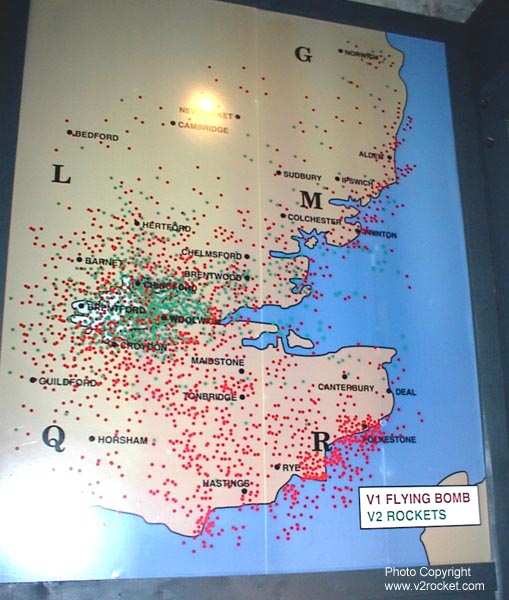
It's scary to look at an area of the city where friends and family live and see just how many people died there. Frequently 10 or 20, the highest number is 168 when a V2 dropped on a Woolworths in New Cross.
These things hit the ground at around 1800 mph. I guess when you get absolutely no warning there's no time to seek shelter.
This prompted me to look up UK total civilian casualties at https://en.wikipedia.org/wiki/World_War_II_casualties#Human_... , giving the surprisingly small figure of 67,200 (including commonwealth!). We didn't do so badly when you look at some of the other horrifying figures in that table.
That figure of total civilian deaths is also smaller than the death toll of either of the two nuclear bomb attacks or the firebombing of Tokyo. The RAF firebombing of Dresden has unclear casualty figures but seems to be about 20,000.
Edit: thinking about it, the difference between that low number and the others is really the debt owed to the "few" of Fighter Command and the ability to maintain air superiority over England and the Channel, preventing truly extensive bombing and an invasion.
For truly 'extensive bombing' the Germans would have required heavy bombers, which they did not possess. The Luftwaffe had been largely conceived of as a support to ground troops with no strategic role or capability. Also they wasted their efforts on civilian centres such as London before they had achieved air superiority by destroying the RAF, which they came very close to doing in the late summer of 1940.
They never came close to getting air superiority, or pushing the RAF away from the South England Airfields.
This is a persistent claim that has no support with experts of WW2, but somehow the story is just to good not to be retold by every tv movie and school book. Its a popularised myth with no truth.
Neither is it true that Churchill deliberately attacked German cities to stop the Luftwaffe from attacking the RAF Airfields.
Churchill speeches and dramatisation is not the same as actual history, no matter how often people repeat the same tale.
The only thing I can add to this debate with my current knowledge is that the British foiled the start of a campaign against the Chain Home radars after the Luftwaffe's first Maximum Effort against one station. Devastation was wreaked, but one or more boffins who showed up to see what could be done observed that there was one functioning transmitter, and jury rigged an antenna for it.
When the Luftwaffe did ECM reconnaissance they couldn't distinguish between it and a functioning station, and concluded that approach wasn't going to work.
Can't remember my source for it, a quick check of the index indicates it wasn't R.V. Jones' superb Most Secret War.
Usually I would not recommend a podcast, however this podcast goes threw the Battle of Britan in extrem detail comparing gains and loses for every single day (!).
WOW I had no idea how many landed in London. I always thought that they were inaccurate and weren't effective. Sure would have terrorized me and came close to Big Ben.
> This map is not comprehensive. Many strikes in open countryside are omitted. And many strikes in the East End of London are missing due to lack of concrete information. Please leave a comment if you have evidence.
Interestingly, the British used double agents to trick the Germans into targeting V-1 and V-2 rockets away from Central London by selectively reporting impacts and adjusting impact timestamps to make them believe that the rockets were overshooting their targets when they were, in fact, falling short.
Ah yes, 'falling short' on places such as the New Cross Woolworths, leading to deaths of 168 persons, and laying waste areas such as Peckham where the fall of ten or more V1s and V2s were packed into a few streets - the area is still partly undeveloped. These unassuming residential and commercial areas took the shots intended for the centre, a few miles North.
The V2 used pendular integrating gyroscopic accelerometers (PIGAs) and gyroscopes for guidance. As far as I know, the V2 was the first use of the PIGA. Descendants of the V2 guidance systems were used by the Apollo moon missions and several US intercontinental ballistic missiles.
The PIGA is actually a pretty cool piece of machinery. You have a free-swinging balance arm that has a mass and a gyroscope on it. The gyroscope's axis of rotation is aligned with the balance arm. An electric motor spins the whole balance arm in a direction perpendicular to both the gyroscope's axis of rotation and the axis about which the balance is free to rotate. So if you remember from Freshman physics, you have a rotational momentum and an applied torque, the resultant torque is the cross product of the two (in other words, a torque in the direction the balance moves freely). An analog controller keeps the electric motor spinning at a rate that keeps the balance beam level. So, the rate the electric motor is turning is proportional to acceleration in the direction of the electric motor's axis. Thus, the integral of the acceleration is proportional to the integral of the rotational velocity of the electric motor. In other words, the number of revolutions of the electric motor is proportional to the velocity of the rocket (relative to free-fall). A simple revolution counter is sufficient to cut off the engine's fuel flow once the rocket has reached a given velocity.
(Source: I interned at Draper Lab, which made the Apollo guidance systems and several ICBM guidance systems. I walked by an Apollo PIGA in a display case every morning.)
I've just started reading it for the first time. Combined with some of the recent Blitzkrieg-related links that have been posted to HN, it's really affecting me.
Just visited DC area, USA and went to the Smithsonian Air and Space museum. That have a V2 on display there. It gives one a palpable impression of their power especially in WWII.
There's also one on display in London at the Imperial War Museum near Lambeth North. I'd read a lot about them, and seen pictures, but it was still far bigger than I expected.


This episode of Dan Carlin's Hardcore History podcast shows how civilized societies could justify to themselves to do fire or nuclear bombing: http://www.dancarlin.com/product/hardcore-history-42-blitz-l...