Whatever the realities of the cost of solar, I tend to worry about a future in which we cover vast swaths of areas with solar panels and the impact such a thing will have on the environment. I don't know if anyone has done good studies on it.
A bunch other sustainable forms of energy have environmental problems. Wind generators cause harm to birds, geothermal electricity sources like in Hawai'i raise the temperature of bodies of water disrupting wildlife. Nuclear power comes with great risks of radiation leakage. Biofuel is hugely inefficient. It seems any solution comes with problems.
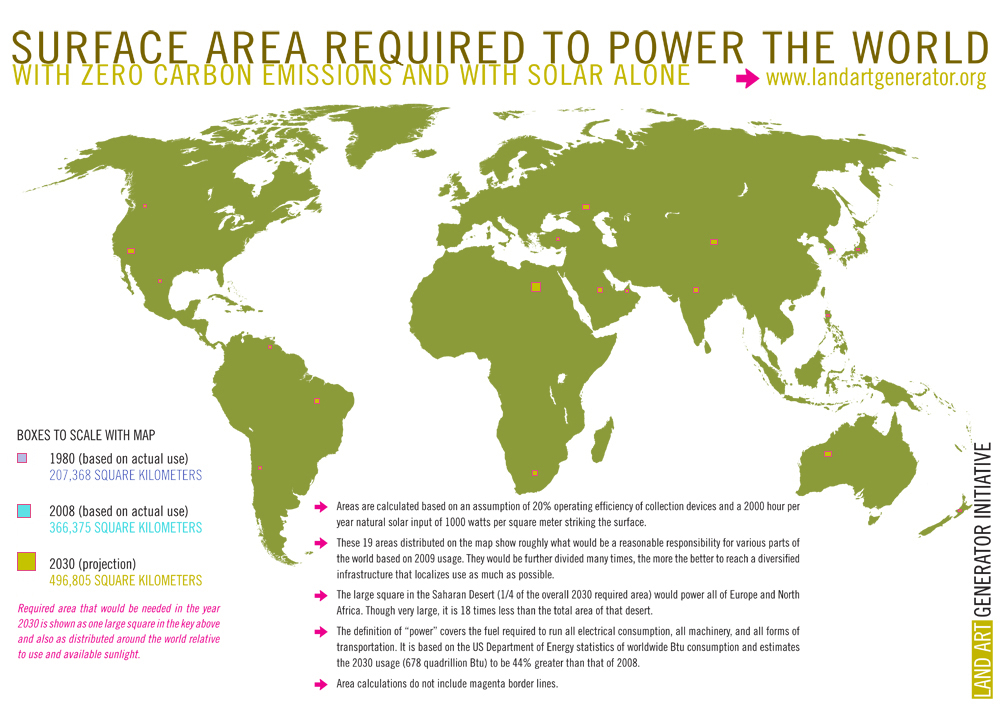
The best location for covering a large area of land for purposes of solar energy would arguably be a desert. "90% of the world’s population lives within range of a desert and could be supplied with solar electricity from there", says this article, which also shows you how much needs to be covered to supply the entire globe in theory: http://cleantechnica.com/2009/06/22/half-a-trillion-dollars-...
There is some type of coating that doesn't allow anything to stick to it. That is a start. I think is called enduroshield. It is not a permanent solution because it wears down but it would help.
Depends. If you assume that w/m^2 still have some growth and that solar panels will be as common on houses as front lawns, and that energy efficiency will continue to rise, it may be appreciably near zero; especially if the average future home becomes a net energy source (These are called zero energy buildings, or ZNE) and we still use wind, geothermal, tidal etc...
If you get high deployment in places with high urban sprawl (lots of rooftops), the long term prospects (say 35 years) negative power bills may become the norm - I know a number of people that already have them.
There's been dramatic gains in solar output and power efficiency in the past few years. The trajectories are looking good.
In solutions that don't require unobtanium, current cells are arguably only about 1/4th of the way there. In solutions that have been constructed regardless of cost, it's still not 1/2 the way.
I think seeing another 100% gain in affordable solutions is conservative, since 400% is what's possible.
If the vast majority of buildings used "negative" power (that is that they generated more back into the grid then they took out) due to small scale power generation on premises, then the net effect may not dictate a need for a grandiose centralized solution.
When people compare say a million homes power needs, which is about 1000Gwh/month, in the non-distributed systems you need a 1000Gwh/month solution (think nuclear). However, this hypothetical 4-fold increase in efficiency would need only 7 solar panel (1.6m x 1m) per house for a net zero need distributed system.
If the right market incentives were there, and in a future market anticipating the swanson curve, someone may install say 25 panels (18 in excess of their need) to generate monthly passive income ("fans" of solar have 30+ panels)
Under this model, someone would be powering their house and two of their neighbors.
You can see how this can add up with the right market structure.
My argument is that in a world of a free-market entrepreneurial energy, you won't need a centralized power generator capable of powering 1 million homes. In fact, you may not need centralized power generation at all.
The future problems aren't going to be in power generation, but in storage.
The Australian government did a study on this[1] as it was claimed that the Orange-bellied Parrot (an endangered species) was at risk from wind farm developments. They concluded:
"The potential threat that wind farm developments in Tasmania, western Victoria and south-eastern South Australia pose to the Orange-bellied Parrot has been quantified in the Wind farm Birdstrike Cumulative Risk Assessment Report (Smales et al. 2005). The assessment report concluded that the predicted annual cumulative mortality rate from all the wind farms modelled corresponds to an additional Orange-bellied Parrot mortality of around one bird per year."
The full study. "Wind farm collision risk for birds" can be found at [2].
I once drove from Sydney to Cooktown (according to Google, 30hrs over 2720.4km, which sounds about right) and horribly managed to kill 2 birds, 1 wombat and 1 wallaby. I'd hate to think what the truck transport industry kills with every single trip compared to this apparent risk from wind-farms.
Last month I drove from Launceston to Scottsdale, I stopped counting dead wallabys at I recon about 120 (pademelons propably, hard to tell if their spread so thin). Many of those were in pairs, a bigger smear, followed by a smaller, joey-sized smear... Amazingly I only almost killed one, and managed to drive over a echidna (missed him)
Took the fun edge of an otherwise very pleasant island trip.
A colleague recalls a trip from Perth to Port Hedland on a overnight bus when she was doing picking up north as a student. Bus has a formidable roo-bar. During the night she was constantly woken up by annoying "pings" from the front. Early morning se got off at a stop to take a piss and witnessed the driver hosing of the roo bar. Something he did at most stops up.
> I don't know if anyone has done good studies on it.
And why would they! If an industry or country can get an advantage out of a renewable tech, it's not in their interests to fund studies if they could give the wrong answers. That's the reality of it. Biofuel was a good case in point, it's proponents are now back peddling pretty fast. The drive to profit forbids foresight.
You can add diesel cars, electric cars, and CFD, LED bulbs to that list too.
Have a look at this picture - it shows the total area needed to be covered by solar to power the whole world. With efficient energy transmission technology the area is negligilbe.
> Whatever the realities of the cost of solar, I tend to worry about a future in which we cover vast swaths of areas with solar panels and the impact such a thing will have on the environment.
Compared to the downsides of coal and gas and the risks of nuclear? I really don't think you should worry.



A bunch other sustainable forms of energy have environmental problems. Wind generators cause harm to birds, geothermal electricity sources like in Hawai'i raise the temperature of bodies of water disrupting wildlife. Nuclear power comes with great risks of radiation leakage. Biofuel is hugely inefficient. It seems any solution comes with problems.