Whilst very impressive, it's a bit exaggerated, they should have been locked to the same framerate for comparison:
* 9900k is boosting to 5ghz which is sacrificing efficiency.
* 9900k PC is delivering a much higher framerate, so it'd also have much higher GPU utilisation.
* Afaik RTX3090 will have high power draw even at low utilisation (large card, lots of memory).
From anandtech:
>Should users be interested, in our testing at 4C/4T and 3.0 GHz, the Core i9-9900K only hit 23W power. Doubling the cores and adding another 50%+ to the frequency causes an almost 7x increase in power consumption.
Except it didn't. The 9900K was in a completely different performance category from the M1 in these dolphin tests.
To compare efficiency you need to control for performance. What Dolphin did here would be like trying to compare CPU coolers without controlling for power consumption.
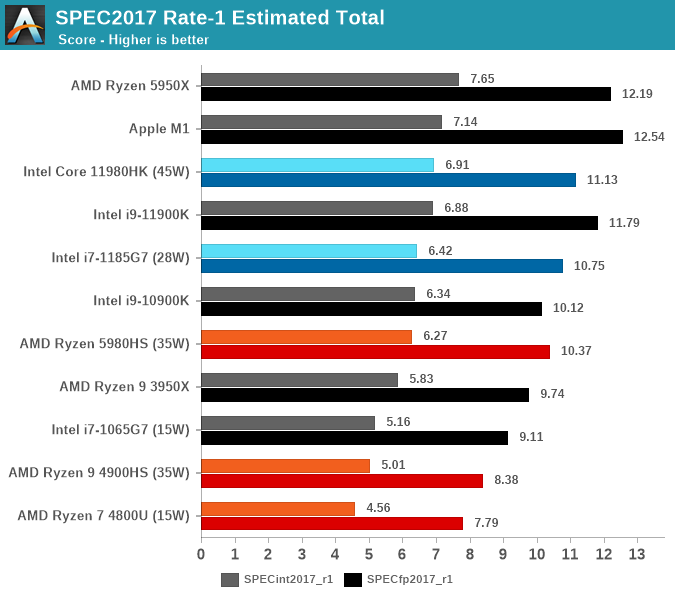
What makes the M1 impressive is its performance relative to other CPUs in its power category (eg, the M1 vs. the i7-1185G7 in this chart: https://images.anandtech.com/graphs/graph16680/117493.png ), or when it manages to be both faster and use less power. That's impressive.
But using less power while also being significantly slower (which is what Dolphin's comparison is saying)? That's... not impressive or interesting. That's some "no shit sherlock" level stuff - just compare literally any mobile CPU from Intel or AMD vs. the desktop equivalent in the same generation. You'll see a chart that looks basically the same, with the mobile CPU many times more power efficient while also being a lot slower. Especially when you're taking the top-end desktop CPU for the comparison, the CPU where power efficiency isn't even remotely a design goal.
As I understand it, OP is annoyed by the graph because they are comparing different things at different scale.
I will use another John Deere metaphor: a Prius can cover a much longer distance on the same amount of fuel, but if I need a John Deere it's because the Prius can't do the same job and I am willing to sacrifice fuel efficiency for raw power.
In other words: how much more does the i9 consumes to produce the same FPS of an M1?
We don't know, but we know power consumption increase on these CPUs is non linear, meaning that the 60-65% of the frame rate could potentially lead to 5-6 times less energy used.
Probabky I should have re-quoted what OP posted to make my point clearer
From anandtech:
«Should users be interested, in our testing at 4C/4T and 3.0 GHz, the Core i9-9900K only hit 23W power. Doubling the cores and adding another 50%+ to the frequency causes an almost 7x increase in power consumption»
The i9 4C/4T 3Ghz consumes 23 watt
how many FPS can that produce?
the one benchmarked consumes more than 7 times that (it's a 5 GHz 8C/16T), and it's sure it's not 7 times faster (not even close)
They are actually not doing the same job, they ate trying to go as fast as they can.
But what if they measured how much energy each one uses to produce the same score?
It's a petty thing, but that chart annoys me to no end. The numerator is FPS, not frames, so frames / watt should've been labeled frames / joule (or, well, FPS / watt, but that's nowhere near as fun).