I totally agree with the article but god do I hate when people say "we only have N years left!" as it is something for all the climate change deniers to focus on and attack to discount the points made so the conversation just focuses on some stupid number that is nothing of real value and nothing moves forward. We get stuck in this dumb loop.
The reality is we're already too fucking late. We should have been doing things 50 years ago but we didn't and so the future is already written. 5 years. 10 years. 20 years. 50 years. 100 years. It is all fucked.
From all the things I have seen and read from experts over the past ten or so years there isn't really anything we can actually do so that things are less fucked in our lifetimes. And probably in the lifetime of people born just today.
So actions we take are for the benefit of people who do not even exist yet and it seems pretty much impossible to get people to care about the future of the human race if it means making life 'more difficult' now and probably for the rest of their lives.
The same has been true, probably, for all of human history but certainly so in the past 50 years. Seems the vast majority didn't really give a shit 50 years ago or 40 years ago or ... as basically fuck all has been done outside of token gestures and bullshit targets that there is no real penalty if you fail to meet because, after all, who gives a fuck about the future when you can have a few more quarters of exponential growth for share holders and pay a bit to "offset" your carbon footprint.
> From all the things I have seen and read from experts over the past ten or so years there isn't really anything we can actually do so that things are less fucked in our lifetimes.
While that's what we once thought, the latest science says it's not true. If we stopped emitting carbon immediately, warming would halt (not reverse but halt) within a few decades:
> If we stopped emitting carbon immediately, warming would halt (not reverse but halt) within a few decades
Again it comes down to caring about decades in the future. Look at the age of people who control everything. There are very few people under forty so if we take “a few decades” to mean forty years even people in their thirties are going to be near end of life before we see any benefit.
For the majority of people in positions of power they are in their fifties, sixties or seventies. They just don’t care about forty years+ in the future.
They say they care for their grandchildren’s futures but they clearly don’t as they never take strong action. They act as if pathetic targets will make a difference when what we need is extreme reductions.
You're telling me why we won't make change, whereas previously you were claiming there's no point in making any change in the first place because we're already "fucked".
And I happen to agree with you on this point.
We can do something to change our future and we can start today.
But I'm quite sure we won't, for the reasons you cite and many more besides, including the persistent myth that we're already screwed and there's no point in trying.
And then we have folks like BackBlast who, in the desire to resist any and all necessary change, seem to have, over the last 20 years as the evidence has become undeniable, switched from climate change denial to climate change dismissiveness to now climate change acceptance. It's deeply disheartening and entirely predictable.
Wouldn't most agree that the chaos of stopping -all- carbon emissions tomorrow would likely be far more damaging to humanity than what global warming will do in the next few decades if we don't?
The very same evidence means If we slow carbon emissions over, say, the next decade, warming will slow accordingly with a lag of a few decades.
If we reduce emissions a lot, warming will slow a lot.
If we stop emissions warning will stop.
All within our lifetimes.
And every fraction of a degree the globe doesn't warm will have significant impacts to outcomes due to the non-linear effects highlighted in this article.
The OPs claim is we can't do anything now to change our trajectory within ours or even our children's lifetimes; that the trajectory of climate change is locked in at this point thanks to the carbon we've already emitted; that "5 years. 10 years. 20 years. 50 years. 100 years. It is all fucked." and that "the future is already written."
That's simply false, though in the OPs defense we've only come to understand that recently due to improved modelling.
We can meaningfully change our future today. We simply refuse to do so.
It's not a straw man. Effects of warming are guesses. Stopping the activities that release carbon is understood much better and stopping cold turkey rights now will very likely result in economic depression, blackouts, inability to heat homes, and death.
The main question is, do we invest in a future mitigation or to get off carbon emissions now? Future mitigation had a lot to recommend it from a risk perspective, we wouldn't be throwing good money after bad policy like we might be doing now.
No they're not, though you betray a deep ignorance of the science and success of climate modelling by making use of this well-worn rhetorical falsehood.
> stopping cold turkey rights now will very likely result in economic depression, blackouts, inability to heat homes, and death.
Yup still a straw man.
> The main question is, do we invest in a future mitigation or to get off carbon emissions now?
And now it's a false dichotomy.
We can and should do all the things: carbon emission reductions now aiming toward net zero, including transition to renewables, efficiency improvements, carbon capture, etc. We should also start scrubbing carbon from the atmosphere, planting trees, and whatever else it takes to get atmospheric carbon levels down.
And much of that will help buy us time for societal adaptation: moving folks from coastal areas or regions where the wet bulb temperature will become fatal, making changes to our food supply, etc, etc, all while continuing to decarbonize.
BTW, I wouldn't waste time replying. My main goal was to ensure anyone coming across this thread saw a counterargument to what you're putting into the world. It's pretty clear based on you comment history that you won't be moved by some rando on the internet so there's little point in continuing this discussion.
You're describing people as if they are selfish and don't care about the future of humanity. That's not what this is. This is a tragedy of the commons. Virtually no single person has the power to combat climate change. If I could make a meaningful difference, I would happily trade my comfortable existence to save the planet. But I can't. Nothing I do will make a difference. So why should I reduce my carbon foot print or make any other sacrifice, when the world will be just the same with or without my sacrifice?
And there you go, a few billion people thinking like me and suddenly this group has real (negative) impact.
When I was a kid I saw a poster about littering, which made a big impact on me. The poster just had a background of rubbish covered with speech bubbles all saying "my one bit of litter won't make any difference".
So while I agree that many people will not change unless they see everyone else doing it, I still think it is worth trying to make a difference on a personal level, even if only to satisfy my own conscience.
If you make a change out of a sense of moral obligation ("conscience", as you put it), that's applaudable. Moral obligation can also be a good hook to appeal to people to change their habits. However, one person's behavior has no impact. It does not "make a difference". When you say that you're "trying to make a difference", that doesn't make sense to me, because there's no plausible mechanism by which you could achieve that difference.
Yes. A person isn’t really selfish and will almost always make sacrifices to be better. But people as a whole are selfish for exactly the reasons you said.
When I say people I don’t mean an individual person.
Can we stop this already please? Incalculable damage has been done to the cause by people pretending there exists a hard deadline and then later the deniers come in and say "ha where is your apocalypse?"
Also the title needs to match the article title, in accordance with HN posting guidelines.
I see it in older folks. They dont care at all about any of it because they have literally been told since the 60/70s that theres only X more years before Y happens, and every single time the date passes and the dire prognostication does not occur.
Is it accurate to call it "crisis fatigue" or more accurate to call it "Chicken Little fatigue?" It's reasonable to assume this time is not different when in the past the warnings were just as dire and just as apocalyptic. In other words, it's quite rational to respond this way.
To use a different fable, let me point out that the moral of "The boy who cried wolf" isn't that you shouldn't listen to liars, it's that if you get used to ignoring warnings you'll eventually end up with no sheep.
The other half is that if you exaggerate dangers for too long and the dangers never come, nobody can be expected to take you seriously when you warn them of the arrival of real danger
I guess I'm one of the "older folks" the parent post was talking about, and the "dire prognostications" I grew up with were much more severe than any of that.
I grew up with things like the population explosion predictions of the 1970s, that mass famine would kill hundreds of millions and that famine would spread to industrialized countries. That was when the population of the world was under 4 billion. Things like Erlich's bet that commodity prices would skyrocket. The Hubbert peak theory for oil, anyone remember the Oil Drum blog? And of course many, many permutations of, "if we don't do X by date Y, it will be too late for humanity. Won't somebody please think of the children"? Y is usually at least 10 years out, 8 years is a pretty bold departure for this genre.
I don't pay much attention to doom porn anymore, I guess I'm glad that the end of the world keeps getting pushed back for a few more years.
We are starting to see crop yields decline in some tropical countries due to drought and higher temperatures. This is one factor behind unrest and migration in Central America and the Middle East.
>> We are starting to see crop yields decline in some tropical countries
We are seeing crop yields rise in other tropical countries.
The prediction wasn't that crop yields would fall in some countries and rise in others with the overall result being steadily increasing food production per capita through the 2020's.
The prediction was massive famine with hundreds of millions dead in the 1970s spreading to the industrialized world by 2000. And the prediction wasn't based on climate change, it was based on simple population growth.
We currently have the lowest percentage of people living in absolute poverty in all of human history. And the birth rate is under the replacement birth rate almost everywhere outside of Africa.
The doom population explosion scenario that was predicted simply did not happen. Technology won.
The western states are looking at historic droughts right now. This year is going to see some pretty poor crop yields. All indicators are this is something that's going to continue for several years.
Is this what has been happening or have the dire prognostications been different over time and just mashed together by the media/people not remembering the details?
In 1980, was the prediction that there would be experiencing the consequences of climate change, such as coral bleaching? As that is happening now. So warning that we need to avoid climate change for the past 50 years makes perfect sense.
This is not a singular disaster, but rather a sliding scale.
I see they've updated their estimate to the more cautious (and less precise) figure of "sometime between 2030 and 2080". A more readily falsifiable prediction, therefore, is Harvard University professor James Anderson's 2018 claim that:
"The chance that there will be any permanent ice left in the Arctic after 2022 is essentially zero"
That's a great example but there's something about looking at a glacier, right in front of you, and having a placard that says it will be gone in one year that really rings the cognitive dissonance of the inaccuracy of 'the science'.
It might be too late to try sewing together a parachute though.
This is the problem with putting deadlines on climate change: if the deadline is too close to the present day, people will say "We're too late to do anything about it", and if it's too far away people will say "Ah, we'll fix that later".
Might it be better to present plausible alternatives, in a reasonable timeframe?
Like, if we implement cap & trade amongst developed countries, with a tariff for those not participating (probably china) and with an annual cap reduction.
If not enacted in 15 years we expect: these non-exaggerated bad things
If enacted in 15 years we expect: these bad, but not as bad changes
Can we give that a pithy name? I heard things like Climate-shot, but we can do better.
And can we identify the consequences with a few good metaphors or slogans?
Politically if we could make it competition, would that have broader appeal? Such as, is there a way to get candidates on the right to argue over how their version of the plan will totally outdo whatever China is doing, or remake our industry to that much better than China, or otherwise be exceptional on some kind of madeup benchmark.
Many comments here take issue with previous warnings that haven't materialized, that dealines are missed/bad.
It sounds like we're trying hard to not do anything because those naughty people in the '60s and'70s cried wolf and there was no wolf.
Well, I'm one of those 70's people. Turned 51 this year. And I try. I have a BMW I hardly ever drive because I bought an electric-assist cargo bike.
I use that bike for the school run (~50km per day). I do the grocery shopping with it. I take the recyclable trash to the recycling yard, about 7km away.
There are some other things, like my herb garden, reducing the numbers of electric items in the house, eating less meat (this one is hard but we're winning slowly). Train when we go on vacation.
We can criticise the old folk, call foul on the scare tactics being used on us these days...
...or we can take it on board and start doing the little things.
And OMG imagine, we could maybe even stop looking for ways to criticize the government and those people from long ago, cut out the negativity, and stop making fun of Prius drivers.
One of the problems that the article started to articulate, but didn't fully cover is that even if everyone on the planet did similar things in the personal lives ... it is not enough. Energy use and emissions are all about industry. To a certain extent one can patronize low-carbon emissions businesses, but most of those are either low carbon to begin with (often with high margins) or are using bullshit offsets.
Really that only things that can reduce emissions are regulations & taxes or new technologies. And maybe geoengineering, but that is speculative enough to not enter serious policy debates.
Applied R&D is incentived very heavily via taxes, so we don't need to mess around there too much. Basic research should be better funded though.
Probably the best proposals we've seen are the various forms of cap & trade for domestic industry or treaty partners adopting a common market, with tariffs for foreign production outside of cap&trade regime.
The EU's "Fit for 55" is the only tangible step in this direction I've seen.
So it's better to just throw up or hands and do nothing? If what I do isn't enough, surely it contributes something, right?
If we all only ever think of this as someone else's problem, nothing will change. The guy that passes legislation to fix this also has trash to recycle, ideally has an EV, and hopefully a son or daughter that looks up to the likes of Greta Thunberg...
The comments here sound so fatalist. It disappeared off the home page really fast too which suggests most don't want to face climate change.
Which is a shame. Our legacy could be amazing. But, for example, lauding Bezos for his ego trip to space seems more to people's tastes than to object to the planet-destroying consumer culture his company promotes.
This is right up there with the absurdity of colonising Mars when people are still starving on earth.
I wish more people thought like you about things like this. I'm in my mid-fifties and been riding a bike most of my life rather than buying a car; I try my best to recycle; I try not to waste; etc, etc; and been doing all these things since I saw as a child many scientists give advance warning on TV and in various magazines and other publications about pretty much all the things that are now happening.
Truth is most of the messes the world is in right now were avoidable, except that the vast majority of humans would rather ridicule and harass anyone trying to make a better tomorrow than allow anyone to succeed at such "lofty" and "naïve" goals. I've truly lost all hope for humanity as a whole, because the percentage of people who actually care about anything beyond themselves is vanishingly small.
No, the argument is that we should be actively supporting changes industrial regulation. That might mean writing wonky letters to congress or the editor, it might be protesting a factory, it might mean boycotting a company with certain practices. It certainly means being involved in the political process.
None of that means one shouldn't also make changes their personal lifestyle, but the problem is that plenty of people see that as sufficient. "Well, I'm a vegan and bike to work, so I've done my part." Or worse, a more watered down "I recycle." Those views are just a bad as the person that considers the problem too big and throws up their hands in defeat.
> If what I do isn't enough, surely it contributes something, right?
No, it quite possibly might NOT contribute something worthwhile. At least not enough to change the climate. _So we need to make it enough_ We need ways for citizens to contribute more meaningfully than virtue signaling.
Significant climate change is inevitable, in essence it has already happened and the future increases are already locked in. "let's halt carbon emissions in a few months" isn't going to happen. "let's halt carbon emissions in a few years" isn't going to happen. It also wouldn't end up making a terrific amount of difference.
Some places which are nice and habitable are going to be uninhabitable (or underwater) in 100 years. Some places which are uninhabitable are going to become habitable. Some species are going to die out, there will be wars, famines, and suffering... just as there always has been. Life isn't a constant slow march upwards towards prosperity, it is messy. There is change, there always has been change and there always will be.
There might be natural feedback systems that make a big dent in the negative outcomes and there might be ways that humans can promote these (if the ice caps melt and it becomes warm in the polar regions, we might get a carpet of freshwater plants covering the oceans again which is a tremendous carbon sink, likewise we might be able to fertilize barren ocean regions to trigger algal blooms which will sink carbon into ocean depths).
But... it's already done. It probably won't be as good or as bad as some people think, humans will adapt and global ecology will adapt.
The attitude needs to be more "how do we make this best of what's to come?" instead of "the end is near!"
>Actually the emissions and environmental damage are ongoing, and we need to stop doing them or the end result will be much worse.
Things already are the way they are and the way things are going to be in the intermediate future is already predictable.
>Personally I think we should change our behavior that will lead to wars, famines, and suffering.
Oftentimes this is more of a matter of exchanging one cause for another. Global austerity and dramatic changes in energy sourcing and production would also cause... wars, famines, and suffering.
And the solution is essentially already here. Solar is among the cheapest energy sources and growing dramatically and battery tech is at the point where it can replace fossil fuels for all sorts of transport and mobile energy/work needs. The best we can do is accelerate the growth of these things a little bit more, but in reality we can only make a small difference, new technologies grow at the rate they grow.
The fact a huge amount of horrible things are already locked in does not mean that we shouldn't try to prevent locking in even more things. Especially as things probably become exponentially worse the more emissions are locked in.
It completely escapes me why this basic concept is so hard to understand for so many people. "Things are bad, so let's actively fight to make sure things are vastly worse in the future." I fail to grasp how that logic is somehow better and more defensible than your simple and obvious logic; "Things are bad, so let's start making them better, or at least stop making things worse."
The author argues in two directions that you either fail to recognize or ignore. First, it is still possible to change something for the better, it is not yet "inevitable". Second, should this not happen, then it is not about "some places" and "some species" but about the quality of all biological live, including all of us humans. And then it is no longer done with a bit of adaptation as Darwin suggested, but really all (except maybe a few billionaires who prefer to be shot in a rocket to the moon) will have an existential problem. So, do not think how can we make the best of what's to come, but try everything to minimize the damage as long as we still have a hint of control. I plead that this is what makes us rational beings.
I think people are missing the point that (I think) you are making. "The end is nigh" is not a mentality that is conducive to productive action. "The end is not nigh" doesn't necessarily mean "don't worry about it", it means "the future is going to involve living with the consequences of today's (and yesterday's) actions".
So one assumes you're super cool if wherever it is you live or come from is the place that becomes uninhabitable, then. If it's your family that has to abandon their home and become refugees. That's just the way things work.
Or do you have enough money that this isn't a problem you're terribly worried about? Can you just up stakes and move to another place and obtain residency and live off of savings or remote work until you can legally work in your new habitable home, confident that all of this is very normal and easy to adjust to?
Sometimes, reading the comments on this site, I wonder how the tech industry has a reputation for attracting the brightest people on earth.
More or less everybody had ancestors that uprooted and moved to vastly different locations in search of better opportunities, most Americans are the descendants or were themselves rather poor immigrants. The tech scene is especially full of people who are first or second generation.
The world changes and it baffles me that some people have this huge sense of entitlement to constancy. Whether you're very poor or very rich you don't have to live paycheck to paycheck, but it usually means making choices that people don't like. Being prepared for an uncertain future is virtuous and there isn't a level of wealth that demarks whether or not this is possible.
If you're living today, maybe buying real estate near sea level is a particularly bad idea, maybe buying real estate in areas threatened by severe drought and wildfires is a bad idea, maybe if you're in these situations already it's worth doing so while there's not a rush.
People on this site tend to be problem-solvers. If your location is to become uninhabitable it isn't going to happen overnight. Whatever happens in your life, there are probably going to be some big bad things for everybody. Do your best with what you have, spend less time fantasizing about changing the inevitable or judging people who assume future problems have solutions that aren't just trying to make change not happen.
It's not inevitable, it's momentum energy in the system that can be relaxed with bio CCS and other net negative emissions approaches. It depends on the effectivenesses of counter GHG plans.
>Life isn't a constant slow march upwards towards prosperity, it is messy. There is change, there always has been change and there always will be.
This is really, really hard to understand for people today because the post-cold-war era, in the west, has been one of unprecedented stability and prosperity. That is ending, and what is happening is a reversion to the mean that looks a lot like catastrophe.
It's bad. It's really bad. And it's already here. So we need to talk about minimizing the forcing and the effects, and stop pretending like we are going to somehow avoid catastrophe.
That means driving emissions toward zero, and carbon removal, and solar geoengineering, and adaptation. All of the above. Climate change is already happening and we're still way behind the curve.
Rather than argue about dates and years, could we talk about the ways we are truly going to overcome this? I doubt a community which prides itself on intelligence and research really has nothing better to say than "where's your apocalypse now?"
I for one desperately want to start hearing actionable plans for carbon (or climate) pricing. Also, while I understand the impact I have as an individual is limited, I also am deeply aware of the fact that needed systemic changes will have an impact on me. Has anyone tried to summarize what we should expect life to look like during and after the needed changes? This will be the path to acceptance, which is somewhat of a prerequisite for policy change in a democracy.
The problem is that timelines are central to the discussion. If we have 8 years, we are limited to existing technology for the most part and geological/biological solutions will be of limited use.
If we have 800 years, we can use more trees and bet more future technology.
Hmmmm, I mean the point is that it's urgent. I think we should all be able to agree on that by now. The weather is to the point it's changing and weather is a far more localized phenomenon.
At the very least we shouldn't be making matters worse by, for example, inventing stupid new ways of wasting precious energy. Conservationism needs to be the new norm, and we can take new technologies that help as the are available. However, much of the work will need to be on the policy side, as unfortunate as that may be to us technologists.
My two cents is that the people you're screaming at haven't left their 25 mile residential / geographical area for more than a few days in the last 30 years. They only have their own worldview to look at.
They'll get serious about climate change when their house is on fire and not a moment sooner.
The only solution is to force a solution from up-high, the way JFK did with the moon race.
Sometimes, like with rabies, once you start to get visible symptoms it is already to late to do something.
With coronavirus we saw what it means to not take action in something that is exponential, just because your reaction time and how broad it should be doesn't follow the progress of the disease, that it is already more severe than what your charts show.
What is left to know is if we are already falling downhill or this was just a bad dice roll in the extreme weather lottery. But it seems to be the former with the changes in the polar vortex.
Really minor nitpick - high speed rail is faster than airplanes for short to medium distances if you include ( as you should) getting to an airport ( usually farther away from where people live), the security theatre there, and the same at arrival.
( Not to mention much more comfortable, eco-friendly, etc.)
On the one hand I understand that conveying this as an average temperature difference makes the value more understandable, but it also makes some people miss the point that this is mostly about heat capture. And that this energy increase in will be noticed in many different ways.
Moreover the process amplifies itself (eg. when some part of glacier melts, this area no longer reflects sunlight back into atmosphere, but the dark water absorbs most of this, which leads to even faster heat absorption).
$600T costs of climate change by 2100. Assuming current global GDP of $90T (which itself makes the claim that global wealth amount to $300T today questionable), and average global growth across that time of 2%, global GDP will be something like $450T annually. Sounds manageable.
Can global warming be though of as the planets way to fight what it thinks is an infection? Kind of like what fevers do for humans? Is that a big stretch?
Millenarian deadlines aside - temperatures are rising, and average annual/monthly temperature records are being broken again and again recently. I don't think you saw this kind of a heat wave in Siberia in the 1990s:
The calls to action I’ve heard since the early 90s were “we should do something in the unspecified near term” and “8 of the 10 hottest years on record were in the last ten years”.
Hmm… I wonder in how many years the statement “8 of the 10 hottest years on record were in the last ten years” was true? I was in the UK, but this could be calculated for any locality.
(...)Yes, I said, now I understand: the question which you would have me consider is, not only how a State, but how a luxurious State is created; and possibly there is no harm in this, for in such a State we shall be more likely to see how justice and injustice originate. In my opinion the true and healthy constitution of the State is the one which I have described. But if you wish also to see a State at fever-heat, I have no objection. For I suspect that many will not be satisfied with the simpler way of life. They will be for adding sofas, and tables, and other furniture; also dainties, and perfumes, and incense, and courtesans, and cakes, all these not of one sort only, but in every variety; we must go beyond the necessaries of which I was at first speaking, such as houses, and clothes, and shoes: the arts of the painter and the embroiderer will have to be set in motion, and gold and ivory and all sorts of materials must be procured.
True, he said.
Then we must enlarge our borders; for the original healthy State is no longer sufficient. Now will the city have to fill and swell with a multitude of callings which are not required by any natural want; such as the whole tribe of hunters and actors, of whom one large class have to do with forms and colours; another will be the votaries of music—poets and their attendant train of rhapsodists, players, dancers, contractors; also makers of divers kinds of articles, including women's dresses. And we shall want more servants. Will not tutors be also in request, and nurses wet and dry, tirewomen and barbers, as well as confectioners and cooks; and swineherds, too, who were not needed and therefore had no place in the former edition of our State, but are needed now? They must not be forgotten: and there will be animals of many other kinds, if people eat them.
Certainly.
And living in this way we shall have much greater need of physicians than before?
Much greater.
And the country which was enough to support the original inhabitants will be too small now, and not enough?
Quite true.
Then a slice of our neighbours' land will be wanted by us for pasture and tillage, and they will want a slice of ours, if, like ourselves, they exceed the limit of necessity, and give themselves up to the unlimited accumulation of wealth?
That, Socrates, will be inevitable.
And so we shall go to war, Glaucon. Shall we not?
Most certainly, he replied.
Then without determining as yet whether war does good or harm, thus much we may affirm, that now we have discovered war to be derived from causes which are also the causes of almost all the evils in States, private as well as public.(...)
The only sure thing is that most of these doom prediction happen to be false.
People writing this kinda things seem to think we can afford reducing the growth society. The sad reality is that if we don't all grow we will suffer way more than what climate change will bring.
Grow up, stop living like peter pan and work to find proper solution instead of complaining.
The end of the growth society is only a disaster if we keep the current economic system unchanged. A world is possible which does not rely on unending growth.
Agreed but we then need to accept to loose most of our modern day comfort, going back to 40years expectancy, most of the population dies ... which is probably not what we should aim for.
Nature works like the rabbit and fox differential model. The only way for the fox, aka we need to try to grow as long as possible otherwise most of us will die brutally
It is a plausible that a larger, richer society can:
* more rapidly improve its technology, both to reduce energy use and to reduce emissions
* afford to pay for mitigations of the problems that do occur
* can consider larger projects like geoengineering
* afford to slow its growth, it is easier to avoid the need for future growth when you are already wealthy
* better make us of economies of scale to improve per-person efficiencies
* specialize in the tasks required to managed a higher climate variance, energy production diverse and more rapidly changing world
Says who? There are plenty of different ways to order production without leaving it in the hands of unaccountable sociopaths. The options aren't extractive capitalism or the stone age. Endless growth isn't inevitable, or even possible.


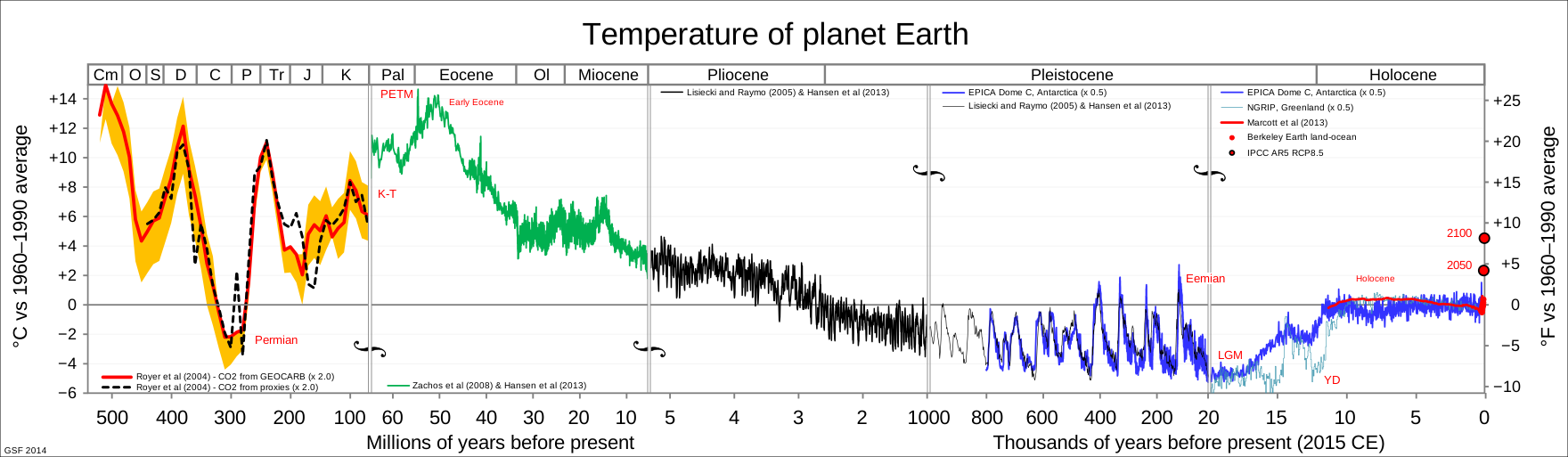
The reality is we're already too fucking late. We should have been doing things 50 years ago but we didn't and so the future is already written. 5 years. 10 years. 20 years. 50 years. 100 years. It is all fucked.
From all the things I have seen and read from experts over the past ten or so years there isn't really anything we can actually do so that things are less fucked in our lifetimes. And probably in the lifetime of people born just today.
So actions we take are for the benefit of people who do not even exist yet and it seems pretty much impossible to get people to care about the future of the human race if it means making life 'more difficult' now and probably for the rest of their lives.
The same has been true, probably, for all of human history but certainly so in the past 50 years. Seems the vast majority didn't really give a shit 50 years ago or 40 years ago or ... as basically fuck all has been done outside of token gestures and bullshit targets that there is no real penalty if you fail to meet because, after all, who gives a fuck about the future when you can have a few more quarters of exponential growth for share holders and pay a bit to "offset" your carbon footprint.