I'm fascinated by how AI poster designs have taken over local advertising in seemingly just the last six months - presumably because ChatGPT Images and Gemini Nano Banana finally got good enough at outputting text without obvious defects in the typography.
The posters all look good - much better than their desktop publishing predecessors. And yet they also eat away at the credibility of the event or business for me.
It's hard to trust a poster when the quality of the design has zero relation to the amount of effort that went into creating it.
But is that a widespread feeling, are the vibes bad for regular people, or is this effectively just old man shouting at clouds?
I was talking to my daughter a few weeks ago about a coffee shop that was opening soon and I said that based on the posters in the window it probably wouldn’t be very good. She didn’t really understand how I could draw that conclusion and I explained that you could tell that they had been stretched to fit the available dimensions in a way that clearly distorted the images and text. And that like… if you’re careless about one thing like that you’re probably careless about other things.
And I think it’s ultimately the same sort of thing? If in your marketing materials you don’t value craft and you take the shortest path rather than embrace your constraints and produce something good within them, then that’s maybe a negative signal about how you treat the thing you actually do.
IME the people I know who embody great craft in a field… they care about it in everything they do, and they don’t do a thing unless they can do it with care. I think sloppy AI is just a very strong signal of someone who doesn’t follow that.
This is so definitely not true in many many cases. The best pizza shops in NYC for decades have been quaint, basic and often messy spaces. The ones with the nice menus and overdone decor were often subpar and would fail. This also applies to the best chinese food. Opening a business is hard, you might be incredibly passionate about pizza or coffee but not have budget for a designer. When traveling I usually have way better food at the unpretentious local street food spots rather than the michelin star ones that are all about presentation.
"Quaint and basic" does not equate to "careless". Also, I wouldn't describe any of the good pizza places I've been to in the city as "messy". If you have some place or some piece of advertising in mind, do please share it.
> if you’re careless about one thing like that you’re probably careless about other things
I'm not convinced. This rule holds only if the two "things" are related. But one can have a passion for serving the best quality coffee, and be a total wreck in graphic arts.
If you're really passionate about serving the best quality coffee, you'll be passionate about the experience around that, and you'll put effort in even if it doesn't pay off.
AI-generated art signals that you didn't put effort in, and so aren't passionate about the experience, and so aren't really passionate about the central thing.
"At least you tried" is not a high standard, but it's the one that AI art fails.
I've thought about the specific example of distorted menu photos before as well and to me it also signals intelligence level in the proprietor. I can't imagine myself in that position, looking at that and saying, "yup, that's good." And I also have a hard time imagining not understanding why it looks bad, what one could have done to not make it bad. It feels like a distinct decision to be lazy.
And like you said, if they are that careless and unadept at one thing, how are they going to work the intricacies of an espresso machine and food safety standards? Not that an espresso machine is that hard to operate, but surely it's more difficult than maintaining the aspect ratio of a photo. You don't even need to know the term "aspect ratio" to get it right.
But I also have to admit that my expectations seem to be very off on this specific issue. My wife is quite intelligent (actual, literal genius) and even quite artsy, and yet I had to teach her how to not resize photos incorrectly, both for aspect ratio and quality by resizing too large. It's seems like such an easy thing to see and figure out to me. This must be how my 10 year old sees my chess play.
If you want to pull good shots you need to be adjusting grind (etc) every day and throughout the day. So it's a case where you have to check and adjust output continuously.
So for me that's especially a case where like, do you pay attention to detail and take time to fix obvious mistakes is probably the number one requirement.
>If you're really passionate about serving the best quality coffee, you'll be passionate about the experience around that
The degree to which the menu is part of "the experience around that" is exactly the debate here; you can't just claim it as axiomatic.
>AI-generated art signals that you didn't put effort in,
or it signals you spend your time sourcing the best beans, understanding the climate of the various bean producing regions, reading trade news for the coffee industry, ...
>"At least you tried" is not a high standard, but it's the one that AI art fails.
I think generally the opposite is true. A place with bad coffee but great decor can charge the same as a place with good coffee but crappy everything else. And so to maximize profitability, it does just that, meaning that at any price level, the place with the worst non-coffee has the best coffee. If you judge them by their posters, then what you’re paying for is the posters.
I think people complaining about AI art at businesses are making an aesthetic argument and then laundering it into ones with more heft. I mostly agree with the aesthetic argument, but it’s only that, not some wider indictment.
You could literally have a blank piece of paper with the word "coffee" printed on it in times new roman and it would look better than off ratio AI slop graphics. It's not a case where better necessarily costs more.
I also think that you are assuming here that the effort not spent on good signs is being spent on good coffee. That might not be true. It might be spent on nice chairs, or it might be being spent on pastries, or on non-coffee drinks, or one of the many other things a coffee shop can focus on. In fact even if coffee, maybe they do brewed coffee and espresso based drinks and cold brew and milk oriented drinks and milk-substitute oriented drinks. Which of these are they spending effort on?
The thing about coffee shops is actually that they tend to do a lot of things, and so unless they do almost of them well there's a good chance they don't do one of the things you care about in a coffee shop well. Consequently it makes sense to say "given that you don't do this thing well, there's a good chance there are other things you don't do well and those things might be important for me in a coffee shop".
While I agree with the general sentiment (people not putting effort is a bad signal), I also think people are sometimes being too harsh. Everybody has limited time and resources and knowledge. Making something (a business, a book, a website, etc.) means making some trade-offs with the resources you got.
When I can easily (without lots of effort/resources) check the quality of something, I prefer not to be that influenced by this type of "bad signals". Think of buying a coffee or trying a sandwich place. When I make a big investment, like a laptop or a TV, yes then it is a different story.
I disagree, but it's also academic. Even if every single one of my assumptions is unfair, they're still being made by me and others. Restaurants need to consider the reputational risk caused by customer perception. There's a whole film about it [1].
I think there's a difference between passively and actively putting no thought into something; generating a menu with AI involves deciding that it's worth having but that you don't care about the quality.
Generally for restaurants, the better the menu looks, the better the decor, the worse the food is. The 'hole in the wall' places are always the hidden gems. The slick-looking places are always a disappointment.
I read this quote somewhere: How you do something is how you do everything. I go by this principle in my life. Lately, I have been thinking in how many cases will this be not true.
>if you’re careless about one thing like that you’re probably careless about other things
ah the inverse of the "i'm good at coding, therefore i am good at everything."
I want my restaurants to have delicious food; I don't expect them to have (or hire) graphic designers. Every dollar spent on design is a dollar that is not going to the quality of my food.
The hate on AI menus is irrational, unless eating at a specific place is meant for its societal signaling value rather than for its food.
Coffee shops do a lot of things. Do they make good espresso? Do they do good brewed coffee? Is their cold brew good? Do they have good pastries? Do they do good milk based drinks? Do they offer milk substitutes? Do the staff make you feel inconvenient or are they pleasant? Are they nice places to sit? Is the WiFi good? Are there power outlets?
You probably don't care about all of those things. Other people probably care about a totally disjoint other set of them. If you ask the proprietor of a coffee shop they might care about some of these things and not the others. But you can't tell in advance.
Once you see one thing done poorly, it's not unreasonable to think other things that are important to you might also seem peripheral to the proprietor but actually be important to you.
No, it's entirely rational to judge a service based on external signals.
If you need medical treatment, will you go to a doctor operating out of an office, or a doctor operating out of their own garage? Theoretically, either one could be good or bad at medicine, but in practice, professionalism is a useful signal.
An ugly AI-generated menu shows a naive disregard for the actual experience of your customers. This attitude will bleed into the food quality.
> Every dollar spent on design is a dollar that is not going to the quality of my food.
Then throw something together in MS Word. That's free. It's not bad for something to be low-effort; it just needs to be commensurately simple.
And the MS Word menu at least conveys human effort. I absolutely don't care if the menu is in one font and looks like an amateur did the layout. I don't expect restaurant owners to be accomplished graphic designers, I do like to see them appear to care and be personally invested in every aspect of their restaurant.
I hear more and more stories about people running into obviously AI-generated stuff whether it's menus, posters, news articles, music, or videos and they find it a turn-off. So if a small business is wanting to use AI, it's probably best to limit it to internal workflows, and not have it be too apparent in your public facing appearance.
>If you need medical treatment, will you go to a doctor operating out of an office, or a doctor operating out of their own garage? Theoretically, either one could be good or bad at medicine, but in practice, professionalism is a useful signal.
Is it a garage that has the same hygiene standards and medical equipment as an office? Your metaphor kinda falls apart here, because those are not orthogonal to the medical service outcomes, the way that a menu is orthogonal to the food quality.
>No, it's entirely rational to judge a service based on external signals.
This is the crux of why we disagree: you think of a restaurant as a seller of a service and you count things like "menu" as part of that service. Thats fine if you want status signaling from your restaurant. I see a restaurant as a purveyor of a good: the food that is produced, and the menu is orthogonal to that. You and I are optimizing for different things.
> Is it a garage that has the same hygiene standards and medical equipment as an office?
Maybe! A garage can be cleaned very thoroughly, especially if you renovate with that in mind. I wouldn't bet on it, though. A good doctor probably could operate out of a garage, but they wouldn't. And a good restaurateur would take time to think about their menu.
These signals select for people with domain knowledge and experience. Status has nothing to do with it. Even the cheapest street food will be evaluated against its competition based on external signals, and so better, more experienced vendors will tend to know how to present themselves well.
All else being equal, would you rather eat a hot dog from a cart with a nice sign, or from a guy sitting on the sidewalk who sharpied "Hotdog $3" on a piece of cardboard?
>All else being equal, would you rather eat a hot dog from a cart with a nice sign, or from a guy sitting on the sidewalk who sharpied "Hotdog $3" on a piece of cardboard?
You keep introducing these silly confounding variables. I wouldn't eat from any hotdog vendor who is sitting on the sidewalk, regardless of their signage. If both had carts, the signage wouldn't affect my decision, particularly because hotdogs are shit in my opinion. As nice sign on a hotdog cart is like putting lipstick on a pig.
I'm introducing examples. It's logical to judge a thing based on its context and circumstances, because those can tell you about the thing. A menu can tell you about a restaurant in the same way that the presence or absence of a cart can tell you about a street-food vendor.
> hotdogs are shit in my opinion
Then by all means, substitute the street food of your preference. Unless you disdain street food in general, which would be irrational, unless eating at a specific place is meant for its societal signaling value rather than for its food :)
> IME the people I know who embody great craft in a field… they care about it in everything they do, and they don’t do a thing unless they can do it with care.
Fully agreed. It's one reason I've taken to doing more things myself at home. I don't even go to coffee shops anymore, I just make coffee at home. For the price of a month's coffee at a local shop, I bought the equipment and learned by practice and watching a lot of James Hoffman (and others) on YouTube. One thing my father taught me that's really stuck with me is: "If something is worth doing, it's worth doing right." That's not just about caring about what you do to get it right, it's also about caring if you're spending your time doing the right things. I do a whole lot less these days than I used to, because I realized a lot of the stuff I used to do was performative or just a waste of time with no upside. The things I do now though, I put my heart and soul into, because I get in return more value/enjoyment from having done it correctly and at its absolute best or at least at my absolute best.
Seeing sloppy work or AI output in the flesh is a hard negative signal for me that I won't engage with a business. Online I see AI output as a signal that whatever business I may be engaging with is probably a scam/scammer. I see interesting things advertised on my feed but hardly ever buy because most of the time their website is clearly AI generated and I have no feeling of assurance that the product is even real or valuable. Something that has had no human thought or reason applied to it is not going to solve any legitimate problem, and therefore I am not going to spend money on it no matter how good it looked in the fraction of a second I saw it in an ad. Seeing that AI output is almost like a stop-break, that lets me think through whether or not its worth having at all.
There is a good chance you will be wrong, but it's not like you will actually check whether or not you were wrong. You are assuming that you are correct, and have already come to the conclusion that the coffee shop is not good. But even if it is good, you will not admit that it is good, because then you will have to admit that you were wrong.
Hopefully, your daughter just politely nodded her head, and did not actually listen to you.
Not just you. There's been a huge pushback in the local music community around this. Concerts listings now prominently feature the name of the poster designer! Humans FTW.
One of the coolest things about seeing a show at the Fillmore is getting the posters they hand out. A number of bands sell, or have their artists, sell show posters (which then become collectible limited editions); it's way less offensive when it's King Gizzard and the Lizard Wizard than when it's Wizards of the Coast.
Going back over a decade (ETA, actually, wow, over two decades), I used to go to shows, not only to see the bands, but also to make sure I got the poster. This one, made by Tim Gough, escaped me: http://www.oldskull.net/wp-content/uploads/2014/04/timgough-...
A friend also called this the “Party Cannon effect”, in reference to black metal festival posters. When lavish detail is available at the push of a button, simplicity stands out far more.
My perspective on this, as someone skeptical of (but also bullish on) AI, is complex and I haven't completely nailed it down.
My knee-jerk reaction is instant credibility loss for the business/person/thing.
Follow-on is sadness (what are we losing in society because of this?), and curiosity: if a polished appearance (even if it is mega plastic) is no longer a sign of quality, then what is? What signals do I need to look for now?
But, wait! Was a high degree of polish ever truly a sign of quality? I've certainly had experiences where a place made every effort to look polished and professional (and generally did a good job at it), but quality missed the mark. In the case of restaurants, a common refrain of mine used to be, "they're trying too hard in the wrong places." Now, I guess, they don't have to try too hard... but they're still not focusing in the right places.
I don't know what to make of it and I go back to still trying to figure out new (or old?) signals for quality.
I have the opposite impression. For me the quality is the cake; polish is just the icing. Putting out a 5-min of effort output with an AI as your image, is all icing and no cake: it has all the right proportions, layout, etc, but something is very wrong with it.
Not sure how diffusion models work in detail so consider this wet neural slop, but I feel like the training data had a sizable portion of it of high quality art, photography, design, and the models captured mostly the polish: the crispiness, the geometry, the contrast: they're after all computable features. It's more difficult to capture the meaningful blurs, the deliberate deviations, and the organic rule breaking. They're properties much harder to "featurize" for, and rely on tags/labeling/descriptions, etc of variable quality.
By all means you can get that with AI anyway, but it also requires you to understand the art itself, and describe it in a way the model produces satisfactory results.
> if a polished appearance (even if it is mega plastic) is no longer a sign of quality, then what is? What signals do I need to look for now?
AI produces apparent uniformity, it makes it harder to distinguish the quality of the underlying process. Same thing happens in all fields, we are all harder to differentiate, then why would you pick me over the others? this is the hard question we are facing now, and it's a desperate situation to be in. Not just artists and people looking for a job, but also companies to their investors and products to customers. All harder to tell apart.
I think this drives a lot of the AI craze. If I can't own my niche anymore, what is my new specialization? We have no answers yet. We have seen this kind of total competition in a domain with cheap imitation in SEO and slop writing.
Or a third party was paid a one-time fee to make something look good - which still isn't a testament to the quality of the first party's service they're providing.
> The posters all look good - much better than their desktop publishing predecessors.
They all look awful to me, visually extremely busy, nowhere to focus. The text is the same. Useless text and visual details everywhere, no opinion about what's important shining through, nothing to focus on.
This is a genuine comment, rather than snark, though I appreciate it might initially look that way.
Your comment is an example of something that seems to accrue around AI users: casual, even gleeful, spite. You don't get this with every technology; there is no significant strand of the pro-3D printing community, for example, that goes around taunting people who don't use printers themselves.
It's significant, I think, that this sort of attitude is common around AI, but not other technologies, and it does have a meaningful impact on public attitudes around it. I'm not sure whether it's a result of using AI, or a characteristic that leads to a propensity for AI, but there's something here.
I think GP is aware that they're waging a culture war, on the side that stands for brutal pragmatism and embracing the race to the bottom, and they know that casual displays of cynicism are the simplest way to prop up their side.
The gleeful spite and disdain for building community norms isn't an accident, it's an attitude they want to normalize.
My job did a 'lunch concert'. A violinist and pianist were invited to play during our lunch hour. Great initiative.
And then they notified us by means of an ai-generated poster involving a photorealistic image of a violinist and pianist playing in an office setting. But not the actual artists, no, fake real artists.
And I feel like that is such an insult to the actual artists? Like, these are real, actual people, with real skills, that are doing real work, and apparently that's the same as these two fake non-existant people?
So yeah, I share your sentiment. But I may just be old woman shouting at clouds with the old man.
Right, and any musicians taking that kind of gig will have professional photos they would happily share that you could just put some text on top of!
With the OP and restaurant menus in general, and to some extent here, it also feels like false advertising: You’re showing an illustration that’s not even based on the real product or people.
>But is that a widespread feeling, are the vibes bad for regular people, or is this effectively just old man shouting at clouds?
A cursory glance at YouGov strongly suggests that people have bad vibes about AI in basically every territory where they're asked about it, and for basically every use-case
I agree with others saying that this doesn't disqualify complaints.
In fact, it can be precisely because they can't tell the difference that they would be concerned about consuming AI outputs when they don't know they are. If someone wants to take a stand and only read human text and human art then we may need regulation to add notices when text and images are LLM outputs.
This touches on the heart of it. AI generates bullshit. By definition. Bullshit is something that is produced without any care for whether it is true or authentic. The bullshitter's only concern is its value to the bullshitter. AI has no notion of truth or honesty. It's all just prompted, predictive streams of output. When we recognize it, we have the same reaction as we do to human-produced bullshit. Maybe even a little worse, because human bullshit at least may have some evidence of humanity in it. AI bullshit doesn't even have that.
Almost none, sadly. Most of the population just doesn't have that skill, which is why places like Facebook are just reams of AI Jesus upvoted to the Moon.
I saw this menu online the other day, and it's not even discernable from the photo what the food products are; it even sets off trypophobia:
I agree. For most people I've talked to, when this topic comes up, they'll tell me they don't like AI, but then cannot really identify it. Especially the elderly folks in my neighborhood. You look at their facebook feeds and it's 100% slop. No joke. Every. Single. Post. Is. AI. Slop. And for the most part they can't tell.
The problem is in 2026 I work in this space and it's getting to the point where I can no longer tell sometimes. By next year we're probably all cooked. My first go-to now on an image is TinEye.. if it first appeared before AI then I know it's safe.
Most people I encounter who complain about AI use it as a shorthand for 'anything I don't like or disagree with'. When asked why they think something was created using genAI, they cannot point out reasons.
What's the argument here? People don't like spit in their food, how many people can tell their food got spat in? Does that mean they're somehow wrong or to be belittled for not liking spit in their food?
It's not an argument, it's an open question: do people who express a dislike of AI know when they see a poster that was generated with assistance from AI?
I meant to ask what the point of the question is basically. What would change, what would it matter for, if the answer was yes or no?
Besides it being so general a question to really be useless as anything but an insinuation IMO, which is why I'm trying to tease that insinuation out. E.g. are people who use Apple left-handed? Are they gay? The answer is "yes, some of them, of course, but also many aren't... why are you asking?"
There is no thing as "just a question, nothing in mind really". That does not exist. The mind that can ask a question cannot arrive at it in a vacuum.
OK, my point here is that a YouGov poll about people's attitude to AI may not tell us anything actionable about how people feel about AI posters - it depends on how good they are at detecting them.
I'm sure many/most don't know that specifically. But as a sibling poster pointed out, people do have a strong sense for "bullshit"--defined here as fairly crass and/or greedy, low-effort marketing or design. Plenty of people detected bullshit before (correctly or not). I suspect that they often detect it more often or more potently now, both as a result of more desperate non-AI marketing/UX and as a result of increasing corporate use of AI. When they identify bullshit, they're able to map that through the current zeitgeist to "this might be AI", or "I am going to call it AI because I don't like it".
I suspect this cohort is a lot larger than the cohort that directly, independently identifies "that was made with AI". But that's just, like, my opinion, man--take it with a grain.
If true, this phenomenon is conflating years of increasingly invasive/desperate marketing spends, widespread product enshittification, and AI usage, but is simultaneously a genuine indication of a big segment of people's distaste.
All that is separate from revealed preference--however disliked, both past and AI-generated-present marketing of the SALE SALE SALE BUY NOW OR YOU'RE INADEQUATE variety works on a lot of people. So whether "dislike of AI" translates into meaningful behavior changes is anyone's guess. But I think there is a phenomenon being identified here, whether or not it's just AI or something more nebulous.
I think that many people are against toxic pesticides in food too, or meat that was inhumanely slaughtered, but there are few signals in the packaging to tell how things are made (besides labels that are dubiously trustworthy). So people might be against everything LLMs represents (bad for local and global environment, made with slave-labour, made by stealing material, removing jobs), without being able to tell something is LLM-generated. However, when they can tell, the gut reaction is disgust and the brand takes a big hit. I know when I notice something as LLM-generated, which I know I don't always do, I'm immediately disgusted by it and avoid it if I can.
> how AI poster designs have taken over local advertising
Tale as old as time: a race to the bottom. Businesses trying to cut corners, thinking they can offset it against losses from exiting customers. If it wasn't, a lot will just cut more corners.
These businesses weren't paying someone to make a flier. The business owner was sweating for an hour in Microsoft Word and producing something that looked terrible.
I expect they are now investing approximately the same about of time iterating in ChatGPT and producing something that genuinely looks like a huge improvement to them.
I said it elsewhere in this thread differently but people want to pretend the options are:
1. Paying a local designer to make a bespoke beautiful poster
OR
2. Use AI
It's not, the money is often just not there to pay someone. So you get whatever the intern or the owner can slap together in whatever tool they know best (which is rarely the best tool for the job).
It's completely understandable that they would reach for LLMs to help improve their posters.
So many people are anti-AI/anti-LLM just because it is AI/LLM, not because it's objectively worse than the alternative. It's tiring.
It's the Electron vs Native argument all over again. Sure, we'd all love hand-crafted, beautiful, low-resource native applications for everything, that takes a lot of time and/or money. It's a decision between Native and Electron, it's a decision between Electron or nothing (or at best only 1 OS supported).
Lost me at the last paragraph. Comparing billion dollar companies to small businesses does not make sense.
The real reason for Electron apps being a thing is that there is very little competition where they are used. If chatting applications could properly communicate with each other based on international standards instead of being silos, nobody in their right mind would use the trash clients that Slack and Whatsapp produce, for instance.
Contributing to this is DMCA anticircumvention. Make a WhatsApp app that doesn't suck? Straight to jail. It's only legal if you make your own entire WhatsApp.
What's weird here is that I should be in total agreement with you.
I love it when AI tools are used to give people the ability to solve problems that previously they could not solve well.
For the fliers I'm talking about here (think a hardware store promoting their summer sale) I don't think the impact on the local poster design community is meaningful.
And yet... the resulting posters put me off. I'm trying to figure out why that is. I think the best explanation I have is the lack of intention behind them - knowing that none of the visual details - the illustrations, the typographic flair - had anyone thinking about them while they were constructed.
> And yet... the resulting posters put me off. I'm trying to figure out why that is. I think the best explanation I have is the lack of intention behind them - knowing that none of the visual details - the illustrations, the typographic flair - had anyone thinking about them while they were constructed.
I think that's exactly it, and it's not really hard to articulate. You are simply noticing the lack of effort, lack of care, and lack of craftsmanship that is inherent in AI-produced slop. This isn't mysticism and it doesn't take a sixth sense to detect. When someone puts no effort into creating something, that lack of effort carries through the entire work, and is (or should be) obvious and easy to spot.
Ask a schoolteacher. They can spot when someone half-asses a term paper, and, at least I hope, they can spot AI slop term papers.
Okay I've been thinking about this a lot lately, and here's my "I'm currently drinking my coffee" take on this. I'm willing to be significantly wrong here, but for the sake of discussion, here's where I think I'm at.
I also agree with
> I love it when AI tools are used to give people the ability to solve problems that previously they could not solve well.
But I also really hate these menus, I see them all the time as well. I think that my conclusion is slightly different than yours: in my opinion, just not a lot of people have taste. That's sort of like, true by the definition of taste, but what I mean is something more specific: it's not because of AI that I dislike these signs. It's because of what you said above:
> producing something that genuinely looks like a huge improvement to them.
While it looks like a huge improvement to them, it does not to me. Our tastes differ.
Here's a version of this that doesn't involve AI at all: last night I ate sushi at a place I'd never been before. Their menu was a bit chaotic, and had a bunch of annotations, along with a guide to those annotations. One section had both "2" and "2 pieces" listed under the options, and so I was confused: what was the difference here? Turns out it's basically just a typo, both mean that. Combine that with some spelling mistakes, and yeah, I had a pretty bad impression of the menu. The sushi was fine though, I'd go back. But this wasn't a super low-end place, so the attention to detail being off made me a bit worried before I actually ate the food.
Same problem, same issue, AI is really the only variable here. And it is the natural downside of "democratization" or "helping more people do more things", naturally, there will be a lot more low-quality stuff out there than before. That's not actually inherently a bad thing. But it can feel weird.
I guess I see very little "soul" in most marketing/advertising in the first place. It was slop well before LLMs entered the scene. If my local hardware store wants to put up a poster for their summer sale I don't care if it's black comic sans on white paper or if it's a AI-generated advertisement. Either way I'm not looking that closely at it and neither version were going to show up in an art museum or recieve design accolades.
There is so little intention in anything (again, even before LLMs) so I don't begrudge places for using LLMs to try and produce similar quality to what larger chains/corps are able to commision.
I see this as similar to things like people wanting "clean ingredients" or "sustainable packaging" or "healthy food" in restaurants/bakeries/etc. They _say_ they want that but they are not at all willing to _pay_ for it. To be clear, I do wish those things were the baseline, but they are not and unfortunately it is near-impossible to compete with other businesses that don't care about those things. At the end of the day consumers see "$15 hamburger" vs "$10 hamburger", the better/fewer ingredients, the better-paid labor, the recyclable packaging, etc simple don't matter. This is _not_ an argument to underpay workers, kill the environment, and fill your hamburgers with sawdust, it's simply a statement on how hard it is to compete when consumers very rarely reward companies for doing things "right" no matter how much lip-service they pay to it.
I've watched a close relative have people say "you should do X thing!" where X is something like "fewer ingredients" or "low calorie" or "healthy"-type things, only to see sales crater after an initial boost. People try it, they feel good about themselves, then they go right back to buying the thing packed with sugar.
There is a wide gulf between "what people say that want" and "how they actually behave". LLMs are currently in a category where people can have visceral reaction and claim "I'd never buy something from a company that does that" but I can tell you right now that won't last. Be anti-bad-design, be anti-bad-code but don't be anti-LLM because that opinion isn't going to age well (and yes, I know _you_ simonw, aren't anti-LLM, I'm speaking generally).
> LLMs are currently in a category where people can have visceral reaction and claim "I'd never buy something from a company that does that" but I can tell you right now that won't last.
Because people are struggling to make ends meet as wealth gets more and more concentrated. It reminds me of that really disgusting joke: why do sheep farmers like to fuck their sheep just at the edge of a cliff? Because they push back.
So yeah, people often make choices they'd rather not make. Doesn't mean anything, just like that sheep doesn't love the farmer and is grinding up against him, it doesn't want to fall of a cliff and die.
And these companies take a few cherry picked snapshots, never show the video, never show the aftermath, and brag about acceptance. Fuck all of that, so much.
People don't want all of humanity to be stolen from by companies who then turn around and sue you if you violate their copyright. That settles all of it, already. All this stuff about quality and economics is irrelevant. We hate people who steal from the little man to enrich the wealthy, always did, always will. Where there is a "we" that isn't just isolated people playing pretend, you will find this as the bedrock, maybe a layer above hating child abuse. And making the "accept child abuse or robber barons" option 10%, 20%, 50000% cheaper doesn't change that in the slightest.
I'll go you one further: the very few ones who do, or don't care, don't matter, because when it comes to ethics and society they already checked out, and can stay checked out. They got old, they lost what they were supposed to hold on to if they ever had it, and that's tragic, but mostly their problem which they want to extend onto the people who don't have it.
> So many people are anti-AI/anti-LLM just because it is AI/LLM, not because it's objectively worse than the alternative. It's tiring.
no, it's because the SNR of AI slop is worse than human creations.
  hamburger: $4.99
  S̵u̸p̸e̷r̷s̶l̵o̷p̵ ̸S̶i̴g̸n̷a̴t̸u̷r̵e̵b̷u̷r̶g̵e̸r̶:̶ ̷$̴4̸.̴9̸9̷(̵b̴a̵s̷e̸ ̵c̴o̸n̵f̷i̶g̶u̵r̶a̵t̴i̴o̸n̴)̴

  The amount of data hasn't changed - it's presentation. The noise is real. Presenting just the prompt to patrons may suffice, but dressing it up with an LLM output is mast^C
I mean, to say something at least somewhat constructive sounding, they could put an EEG cap on a person and show them bunch of AI slop so to establish a vector and a bias term for less offensive and more focused feeling AI generated data, but I don't believe they're doing it.
Exactly. And it's not even only the LLM generated stuff.
There was once a consultant who advertised the website of his (one-man) company when he applied -- pre-LLM. Ok, nice, some info upfront. But looking at the site I was put off: Just a couple of stock photos and generic marketing blurb. Nothing special, nothing personal - just noise.
As someone who was using TTS to listen to this thread, I can tell you this specific post is about 8 minutes of life I will never get back. I'll email you the bill
okay, I'm sorry, and I'll be more aware of the fact from now on that TTS software used by not negligible number of users[1] might not be well equipped to handle "zalgo decoration" of text.
1: this is not even the second time I've seen someone here mention TTS or legal/literal blindness, so I suppose this actually isn't negligible, not sarcastically
You're ignoring the third option, which is to make a PowerPoint slide with a stock photo and print that. Or use an online template. There are a million ways to make a cheap, adequate flyer.
People may think, "oh, it's a bit simple. I guess they're a small business," but so what? If we rule out the option of hiring an actual designer, it's gonna be that or "ew, look at that shitty AI poster."
I called it out a while ago but the largest market to get destroyed by gen AI was never the professional market - it was the gig economy.
The quality of generative AI may not be top-notch, but it presents an easy drop-in replacement for one-off tasks that people previously outsourced to platforms like Fiverr (voiceovers, logo design, clip art, copy editing, translation, etc).
> These businesses weren't paying someone to make a flier.
My very first gig out of engineer school was updating the website and flyers for some nightclub in Paris. I was terribly paid, badly treated, blamed for everything despite them always giving me the elements at the very last minute, but they did pay someone.
> I expect they are now investing approximately the same about of time iterating in ChatGPT
They are definitely _not_ spending an hour iterating with ChatGPT... I would bet a large amount of money that the overwhelming majority pick one of the n options provided from the very first generation result with no further refinements.
To me nothing a human makes has the capacity to be as terrible on an existential level as genAI slop.
> something that genuinely looks like a huge improvement to them
Of course they think it's great, or they wouldn't be doing it. That goes for everyone, with anything, ever. And some customers probably think it's great, too. But if you want me as a customer, to whom all those other opinions are completely irrelevant, you'd be better off just putting a turd glazed with boogers. Doesn't matter what it advertises, I'll know a human made this, and look at the product description.
It's always been like this - businesses signal that they have piles of money to burn by burning it on expensive advertising. Before AI, you would have been dubious of an ad that was amateurish/clipart/etc. because it shows they can't be bothered spending money on professional designers. Back in the day, I heard that websites used Flash content for this reason too because it was expensive to produce.
I think it would be better if consumers stopped using burning money as a measure of whether to buy something.
For me it depends on the details. The baseline is as you say, negative, but there's a plumber not too far from me whose logo is AI generated, and I can't say I'd hold it against them because I wouldn't be hiring them for an eye to artistic credibility in the first place.
With my mere B1 German, I'm not entirely sure if the pun would even work in German, despite "Vorhangen": translated puns sometimes work fine, other times just make no sense at all.
I definitely roll my eyes whenever i see a poster with that obvious-AI-generated cartoon-people style. or the "edgy rock-and-roll poster" style that seems to be so prevalent. It seems that everyone generating posters is using the same 3 prompts! it's maddening.
It's generally bad vibes because honestly, they're ugly. If you're flat broke, are too many non ugly templates out there. Hiring a local person to do a job like this isn't that expensive, either. All else fails, there's a certain charm in an honest diy poster that AI lacks.
If taste is involved, it's even worse vibes. I mean, an AI poster for a cell phone repair shop is whatever. An AI poster for a clothing store? I don't trust their fashion. This could be the deciding factor on if I get Filipino or Chinese (especially cause the food on the menu in the article looks terrible)...


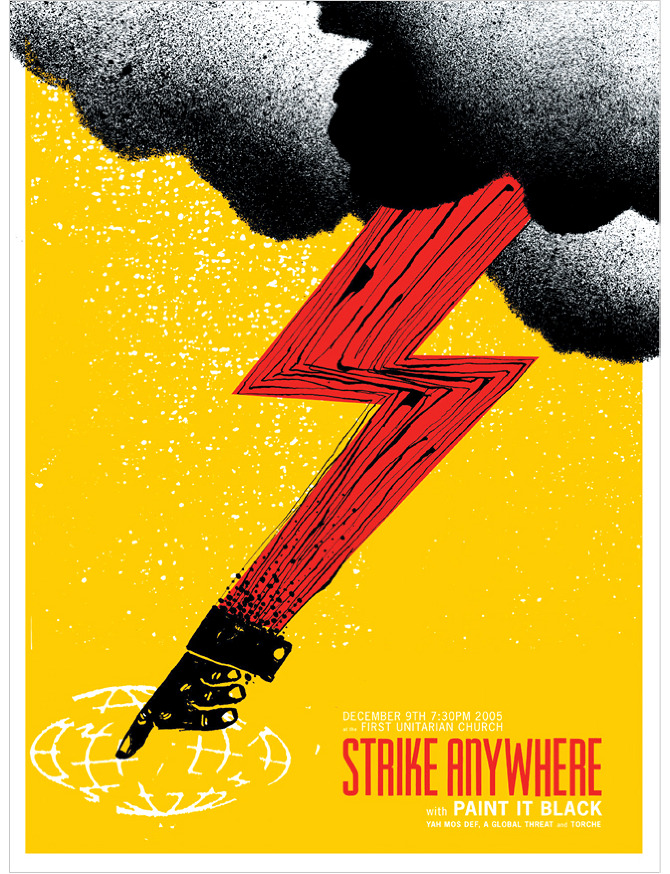


The posters all look good - much better than their desktop publishing predecessors. And yet they also eat away at the credibility of the event or business for me.
It's hard to trust a poster when the quality of the design has zero relation to the amount of effort that went into creating it.
But is that a widespread feeling, are the vibes bad for regular people, or is this effectively just old man shouting at clouds?