I've just bought this phone. Really does live up to its expectations. Yes, it could be thinner, it could have a better camera, it could have expandable memory, but it works, daily use is extremely pleasant, and I don't really feel like I'm missing out on any essential part of the experience. Basically it kills any sensation of needing to get an upgrade out of necessity.
This phone could be the new Nokia 3310. Boy, do I miss that phone. It would last forever on the single charge, and it handles the basic function of a phone (talking to someone) really well.
I can provide some insight from the Indian market over here. I had been on the lookout for the launch of Moto G since Motorola announced it last year. Last month, I purchased the 16 GB model for INR 13,999 (USD 233 at the moment). The price is very convenient for anyone and there aren't any phones which match the hardware specifications of this one.
For those who are used to Motorola's customizations in their phone, you will be missing them because the phone is stock android. The update for KitKat is already out and many people I know have already updated their phones. Till now I have not noticed any issues with the phone and it works very well. I am sure Android developers can make good use of the phone.
> For those who are used to Motorola's customizations in their phone, you will be missing them because the phone is stock android.
That's a selling point for me, at least from my experience using Samsung phones. Some of the add-ons are nice, but the balance seems to result in a fairly sluggish phone.
I think that comment is referring to Motorola's excellent additions that you can find on the Moto X, like Active Display, Touchless Control and Moto Assist.
These really are genuine enhancements rather than bloatware, and they're engineered to use minimal power (using the Xs low-power co-processors and LED screen).
However, for the asking price the G is a great device.
> The price is very convenient for anyone and there aren't any phones which match the hardware specifications of this one.
If you don't mind a (very) slightly slower processor, you can get any one of numerous models from various Chinese manufacturers with dual SIM, expandable storage, removable battery, etc. in the same price range.
Yes, you can get those features but being a Motorola user for a few years, I have never seen quality hardware when it comes to Chinese manufacturers. I might be comparing two very different segments but the entire point of buying from a specific brand boils down to the support and quality received.
This phone has been a brilliant move. Having handled the phone, I can say I truely wouldn't miss anything at all if I were to rely on it (already owned a Nexus 4 though). It's not as future proof because it lacks NFC and 4G, but given that European 3G is usually pretty good and NFC really doesn't seem to be taking off those things don't matter that much.
The only thing I'm left wondering is why other Android manufacturers have not released a similar package. This phone obliterates its competition in its price range; only some of Nokia's Windows Phones provide decent alternatives.
I'll probably be hung for this comment, but I'd still grab the Lumia 625 for the same price myself.
Sure the screen isn't as high res but you get 4G/LTE, an SD slot, guaranteed lifecycle, quality integration with just about every online service and completely 100% offline (unlike google) and free for life turn by turn navigation for vehicles, public transport, on foot and inside buildings.
Also if you've ever broken a Lumia, you'll know the bits are cheap to get and easy to replace without such things as heat guns and odd tools. A T4/T5/T6 torx set and you're sorted.
Smashed my 820 AMOLED screen a week ago and had bits in next day and it installed in 10 minutes.
Before anyone goes "apps apps apps", I only have two additional apps installed other than what shipped with it: an RPN calculator and Adobe Reader
Edit: pricing links as HN has decided I'm posting too fast:
I just bought the moto G, coming from a Lumia 800. Reasons: (besides battery/no win8 etc) Whatsapp is crap, no official telegram app (the unofficial ones are workable), no Bittorrent Sync, no VNC app, the integrated Bing search always makes me go back to Google (and I have tried), my Imap email stopped functioning just like that, no mass storage, instead: Zune. No good standard podcast player (needs Zune). Etc.
That said, Windows Phone is butter smooth and very nice, very well executed but it really is the apps for me.
The Lumia 800 was a WP7.5 device. It's a bit different now with WP8. Battery doesn't suck anymore with the NT kernel, we do have mass storage and it doesn't require Zune anymore. It's a simple MTP device. I can actually plug it into a CentOS 6.5 machine and copy files on and off it quite happily including music/videos.
IMAP is very reliable (better than my wife's iPhone), Google search is integrated into the browser.
I can't say I've tried telegram/whatsapp/bittorrent sync or VNC though.
Can you use Lumia without MS account? I know you can do that with Android (for example using F-Driod repository instead of Google Play), and I'm pretty sure you can't do that with iPhone, but I don't know about Windows Phones.
You need to use a Microsoft account to buy stuff on the WP Store but there is no obligation to use it for anything else, it can be tied to your existing email address and can be closed at any point without any problems.
I've never had to buy an app - the built in ones are awesome and the best others are free (Nokia HERE for example).
You can just chuck a SIM in it and skip the signup when you use it and live with the built in apps as well if you want. It doesn't nag you.
I have this phone and I love it. It flies. It makes phones 3x the price look ridiculous.
It's also super tough. On YouTube, one guy ran over it with a car and submerged it in water and it recovered.
I'm intrigued by the specs of the 'flagship' phones but none of them make any sense next to the G, power-user or not. Unless you game...I have no idea how games run on this thing because I never play.
If only 70% of people in the UK have a smartphone, then we're not quite there yet.
I would suggest that the people buying Moto Gs are switched on enough to find a bargain via online word-of-mouth, but not willing/able to spend the extra money for a top of the line model.
Some percentage will have been bought for people by a more tech-savvy child/partner/etc. but overall I'd say that owning a Moto G would make you geekier than having whatever the latest big advertising push is for.
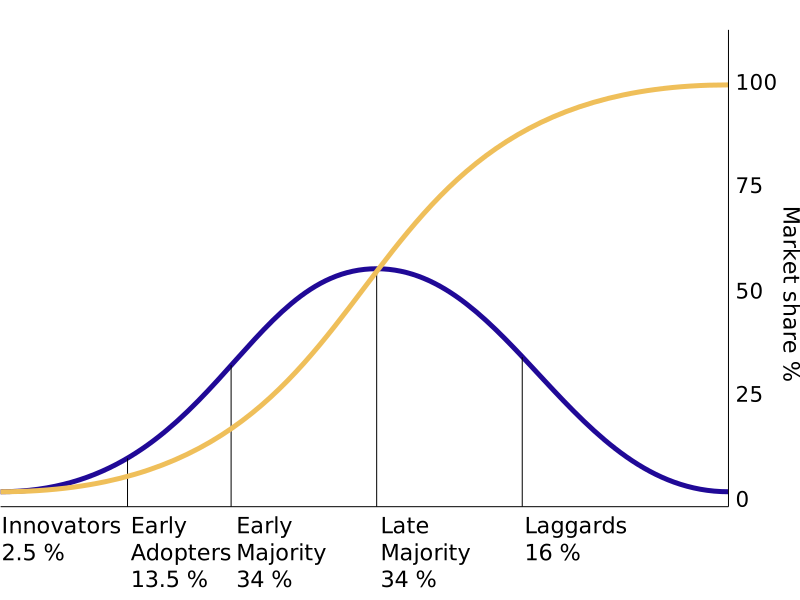
What do the blue and yellow line stand for ?
edit: found the wikipedia page
> The diffusion of innovations according to Rogers. With successive groups of consumers adopting the new technology (shown in blue), its market share (yellow) will eventually reach the saturation level. In mathematics the S curve is known as the logistic function.
That graph seems to blur and merge the distinction between market share and saturation level.
My wife has this phone and it's a great phone (even if it wasn't a budget phone). Really the only thing wrong with it is the camera is slightly sub-par, although for people who use software like Instagram you wouldn't notice. It's no surprise at all that this is killing other phones.
My question: Is Googorola losing money on this phone?
That's certainly implied in the article. And would be a decent strategy as Motorola just needed to become relevant again and it's corporate master can justify subsidizing some handsets if it helps in the OS war against Apple. With Lenovo taking over though that will all be up for review.
It does not help that most US tech sites give the carry subsided prices instead of the true retail cost. For example a review of the iPhone will have a price of $200 instead of $700.
It's getting there. AT&T's pushing their new Mobile Share Value plans pretty hard now, and those are essentially contract-free and directly give you back a $25 subsidy on each phone. You can use Next to spread the payments for your phone over two years, but it's not required.
Business wise, one interesting thing about the G is that it's launched online-only only(or online mostly) ,without big investment in marketing(since the product is so good it markets itself).Those savings are a big part why it's so cheap.
Usually ,in electronics products are priced around 3.5x of their components costs, with most of the cost difference going towards marketing and offline retailers(who than dictate online price). This is usually done in order to get a large volume of orders.
Hopefully the model will shift to online only, offering consumers much lower prices and better products,and a much easier entry point for makers - since getting access to retailers is really hard.
There must've been a tipping point with regards to consumer savviness and free internet-based promotion by 3rd parties (bloggers, forum commenters) purely on the merits of the device (including its price) that allowed Motorola to decide to release a phone online like this and let it speak for itself.
The problem is that phones actually do not market themselves. Samsung have put out some very nice devices but they're not necessarily any better than the competition from e.g. Motorola, HTC and the Nexus line.
Their dominance is clearly due to superior marketing and saturation advertising.
"Usually ,in electronics products are priced around 3.5x of their components costs, with most of the cost difference going towards marketing and offline retailers"
- That's a tad inaccurate. The cost of components is just one cost the manufacturer has. You've forgotten all the other costs around labor, overhead, sales and marketing, storing and moving product. THEN that manufacturer needs to actually post a profit and thus sell the good at a higher price than the costs of its components and sales and marketing/G&A etc.
I think Google's online model only with no advertising would be a cheaper go to market than the traditional way. But no where near the degree you imply. To the point, that isn't responsible for the price difference alone. This phone was being subsidized.
It doesn't fit it at all Hershel. 35% makes a lot of sense relative to sales and marketing and channel costs. 3.5X the price of components with most of that being made up in marketing and offline retailer costs is a completely different statement.
I think i missed something. I just looked at the book "from concept to consumer" and they give an example of a real product that sold at retail for $50(went to retailer through a distributor) while the manufacturer got only $19 ,i.e. 38%.
If it was online only, it could go for half the price , while offering 24% margin($6) for online sale and logistics(excluding shipping), which i believe is pretty reasonable for that market.
The only thing stopping me from buying it now are rumors of an imminent release of a 4G model.
(http://www.knowyourmobile.com/mobile-phones/moto-g/21879/mot...)
(edit yes that article is old but I would hate buying it and then seeing a 4G model released, some suppliers are already out of stock.)
Never used Motorola Android phone but I'm thinking about buying this one somewhere soon. Does Motorola have a practice of "customizing" stock Android OS? If yes, I guess the only options would be rooting or using some of the Nexus devices, which are honestly too expensive for what they offer. Is it a good phone if all I need is more or less stock KitKat that I can use both for development and as a daily phone.
Nothing on the G is customized the way Samsung does or Motorola in the old day did. Motorola added some useful features but they provide them as Play Store apps. The G is essentially stock Android 4.4.2.
(The comment below referring to voice recognition isn't about the G. It's the X that supports always on hands free voice recognition.)
It uses your address list to figure out if someone is allowed to wake you at night with a phone call: You set a time when you like to sleep, and if someone is 'stared' in your address list, it will ring. Otherwise their call will go to voice mail. There's a handy setting that will allow people who call twice in five minutes to ring you in your sleep.
The changes that Motorola have made are mostly positive (such as the always-on voice recognition and Active Notifications feature). However, it's not hard to remove them.
Interestingly my children (12 and 14) won't even look at an Android phone due to iMessage. So if Google/MOTO/Android are capturing males 16-24 that's a pretty dang smart strategy of creating power Google Now users who are heading into the prime of their earning capacity.
You're probably in the US if your children are using iMessage so much. Apple's much smaller marketshare and a lack of unlimited texting plans have made cross-platform messaging apps like Whatsapp dominant in most of the rest of the world.
That said, the young males who are buying the G are "low income", so I'm not sure what their purchasing power down the road will look like. Either way, as smartphone technology starts to stabilize, there's no reason that this price point wouldn't become more attractive to wealthier consumers as well.