I think that's admirable, and doesn't strike me as out of the ordinary for Elon. SpaceX has some remarkable engineering talent (which also transfers tech to Tesla; see their friction stir welding technique that is used by both companies now).
I agree SpaceX recusing itself from winning its own competition is the right thing, but the bit I found interesting was just that they were building a pod as well as the track, putting even more skin in the metaphorical game.
I've had projects before where I came up with an interesting idea but dismissed it as too costly (in time or money or what have you), but it stuck in my head. So then, well maybe I'll just do a quick proof of concept... And then, well, maybe I can hack something a bit more complete together. Eventually, despite myself, it makes it to being a fully formed thing just because it was so interesting I couldn't ignore it.
I'm wondering if the Hyperloop is going to be that sort of thing for Elon et al.
I am pretty sure you were joking, but just in case ... Elon already sat down and decided to learn enough rocket science to found SpaceX, and enough engineering to found Tesla. He's learned more in his "spare time" than most of us have learned at university, and then has gone on to apply the lever of business to it.
If Elon felt that it were necessary to get his pet project done, I believe he'd make time to master civil engineering and politics to the degree that it were necessary.
Civil engineering is fairly rigid and defined by applicable building codes. There isn't any real room to innovate in the industry, at least in the public sector. "Mastering" civil engineering just entails becoming familiar with the code and then it becomes a game of politics and liability.
More likely, he would just hire a civil engineering firm. Laws throughout the country are such that you can't really buy your way into the industry the same way he has with Tesla and SpaceX. Practicing civil engineering requires licensure everywhere in the USA.
After Elon said "fuck it" and built his own rocket motors after getting screwed by the Russians, I don't see him wasting any time with politics or property development (who I'd argue would be leeches/vultures trying to extract their tax on the project).
He's just commission 2-4 TBMs (tunnel boring machines, about ~$20MM/each), drop them in the ground, and have them start digging hyperloop tunnels.
You don't want to do that for reasons that Elon understands well.
Part of Elon's design for the pylons allows the track to remain stable even when the pylons are moved by an earthquake. Which is kind of important with pods moving around Mach 1. Doing the same thing with a tunnel requires you to have cut a large enough hole to shift the tube inside of. Which is a massively harder piece of engineering.
Interested. TBMs are designed to drill through the earth, and then to wrap the tunnel walls with concrete blocks that are rated to last over 100 years. I'm curious if a TBM could cut through the earth and build hyperloop infrastructure behind it as well.
As with everything, there are tradeoffs. Building above ground means land use issues, and the tunnel needs to be so small you can't stand in the hyperloop pods. Building underground means more support infrastructure, but you're limited less by politics and land use problems and more by engineering.
The questions is: which is cheaper to solve? Engineering? Or politics?
The answer is an emphatic no. Concrete can do many things, but it will not hold back a slip fault. Concrete roads, bridges, etc will buckle and break in the slip zone no matter what they are rated for.
Take the 1906 earthquake as an example. As http://pubs.usgs.gov/gip/earthq3/move.html says, the horizontal slip was 21 feet at one point. Something like the Hyperloop has to be designed with the expectation of facing a similar event. Concrete is simply not strong enough to hold back a wall of dirt trying to move 21 feet.
Or for more recent history https://catalog.data.gov/dataset/landers-and-big-bear-califo... where the slip was 18 feet horizontally and 6 feet vertically. And that one demonstrates that it isn't enough to build something special for every slip zone you know about. Because in a real earthquake you are likely to discover slip zones that nobody noticed.
How is the issue of a horizontal slip different for a tunnel versus for an above ground structure? Neither piece of infrastructure can be economically designed to withstand a seismic movement if the structure crosses the fault where the offset occurs.
Why does the possibility of an offset result in a tunnel being an "emphatic no" while still allowing for this pylon idea?
Because steel is very ductile and tough, where as concrete is very strong, but brittle.
Make a tunnel in the ground with concrete and if the ground moves, your tunnel moves too, along with it. Unless your tunnel is stronger than the ground. Which it isn't. Or if it is, it's a 10ft diameter tunnel with 40 foot thick walls. Which is SEVERELY uneconomic.
Make it out of steel and put it in the air, and things get a lot different. The air doesn't make the tunnel move so instead of being surrounded on all sides by things which can exert force (in the ground) it's instead only acted upon by the pylons.
The pylons are supposed to be around every 100 feet. That means if the earth moves 20 feet sideways between two pylons the steel has a chance to bend and move rather than be sheared. And you can design the pylons to be strong enough to hold the tube up, but not so strong as to break the tube. So if things move a long distance, the closest pylons will break free from the tube and the tube will be supported by pylons which are further apart. That reduces the angles necessary to keep the rest of the tube on the remaining pylons which support it, and that means you're asking even less of the steel.
Sure the tube might get some bends in it that it wasn't designed for, and it might even sag down. But you can give the cars braking mechanisms that'll automatically be triggered in an earthquake so that the forces experienced when encountering these new features isn't so unpleasant.
The alternative with the concrete tube in the ground is that the tube shears into two parts which are no longer connected. That means that the tube suddenly stops and you're crashing into the dirt at 500+ mph.
If the pylons are every 100 feet and the joint offset is 20 feet between pylons then that implies a shear strain of .20. This is LARGE for a shear strain. Assuming a shear modulus of 11500 ksi then a shear strain of .2 results in a shear stress of 2300 ksi which is well beyond the ultimate strength of any steel that I've ever worked with.
Now your argument that the tube will just break free of the pylons seems like it has merit; however, the question of "why do we have all these pylons every 100 ft if we only need them every XXX ft?" should immediately spring to mind. The answer obviously lies with the rigidity of the tube between support points.
In order to get into the realm of the possibility for the steel being able to take a 20 ft offset you're talking about putting supports once a mile, at most.
Again, neither the pylon idea nor the tunnel idea have a feasible/economic engineering solution for displacement along a fault if it occurs along alignment.
> why do we have all these pylons every 100 ft if we only need them every XXX ft?
Because most of the time people want to have their design include a safety factor.
Further there's a huge difference between "what this system is designed to do all day every day" and "what this system will do in the 5 minutes between an earthquake beginning and the time that the system is fully halted until repairs can be made"
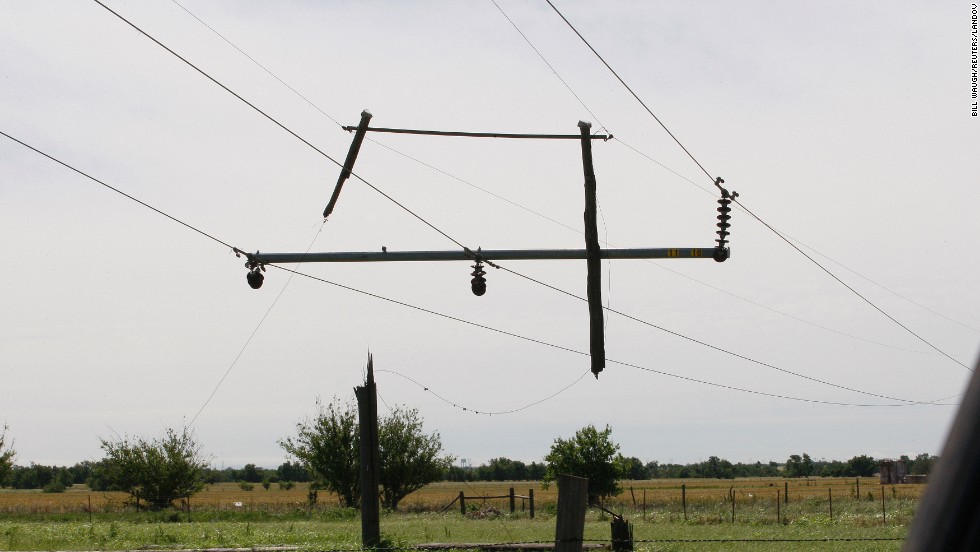
Have you ever seen the remains of a power pole hanging from a power line? That would seem to indicate that there exists excess strength in the system, or that the line support structures are substantially overbuilt.
I suspect that in a hyperloop you could lose 5-10 pylons in a row and what would happen is that the tube would sag well beyond normal operational parameters between the remaining pylons, quite possibly even touching the ground. The reason that so much extra strength will probably exist in the system is that there's a limit to how much deflection you can tolerate without jostling passengers too much for them to buy tickets on a regular basis. And that small deflection means that there's a lot of extra strength in the system, even though it's not strictly needed just to hold things up.
This is why machine tools have giant castings well in excess of the strength needed for the machine to stay together. It's because the Young's modulus matters far more than the yield strength or the ultimate tensile strength when you're trying to build a machine that can hold a sub 0.001" tolerance.
So if you happened to be traveling in that overbuilt tube at 500mph just after it's fallen to the ground, you'd quite likely bump (or smash) your head on the sides and ceiling of your vehicle.
But what you wouldn't do is slam into the dirt that's now at the end of the tube like you would if your buried concrete tube was sheared 20ft by a fault line.
The pylons are built with an internal structure allowing them to move horizontally both ways, and vertically. The tube itself can remain stationary in the air. We do not have a cost effective way to allow the tube to remain stationary if it is attached to the ground and the ground moves. And avoiding buckling and sudden bends kind of matters when you're traveling at mach 1.
I'm sorry but no - this does not answer the question. Expansion joints and "lateral dampers" do not make the problem of a joint offset go away. In order to resist a horizontal or vertical offset of 20+ feet with the tube "remaining stationary" then the pylon must be built to allow an extra 40+ feet to account for this movement.
How, exactly, does the pylon not suffer the same design flaw as the tunnel under the use case that you yourself brought up of a horizontal or vertical offset occuring along a splay?
If each side can move the tunnel 10 feet relative to itself without breaking, you should theoretically be able to handle up to a 20 foot slip between plates. One side bends one away, the other the other way. The pylons move 20 feet relative to each other, and only 10 feet relative to the tube.
That said, my information is based on the blueprint that Elon published and I already linked to. It includes graphs showing numerical simulations of how their design is supposed to respond to earthquakes. If you have further questions, you can start with that, then download the designs that they and others have produced and do your own work.
I am not an engineer. However I do know that engineers have done exactly what I suggested and come to the conclusion that his design is feasible.
The 40 foot figure assumes that the direction of movement is unknown and that one pylon remains fixed. I suppose you could just have each pylon capable of handling 20 feet of three dimensional movement but I doubt the economics work out in favor of that option rather than choosing towers rationally.
That said, your answer is an appeal to authority. Just because a feasibility study says it is feasible does not actually make it feasible. I skimmed the document you linked and nothing in it pertains to large ground movements that would occur due to fault offset - it is all with relation to ground shaking rather than fault slip. Further, it is common knowledge, in fact, that underground structures generally perform better under ground shaking as compared to above ground structures except when the structure crosses the fault which experiences the offset. That is, tunnels work better than pylons except at the point where the large offset occurs.
I understand that you may not be an engineer. I am an engineer, with my area of expertise being in geo-structural interaction, and I am telling you that your statement about a tunnel not being feasible because of earthquakes is NOT correct. There are plenty of other reasons why a tunnel makes no sense for this job, but seismic vulnerability is not a good one. Whether his design is feasible or not is a moot point.
Secondly it is very important that the tube remain still while the pylons move relative to it. Don't forget that we have objects moving down that tube at close to the speed of sound. It doesn't take a large local kink to be a fatal problem for people inside. You really don't want that tube to move. Enough so that keeping the tube still that it is an explicit design consideration to keep it still while the pylons expand and contract for thermal reasons.
Thirdly I well know that earthquakes are generally less of problems underground than on the surface. But trading an easy problem in most places with an impossible problem at fault boundaries is hardly an improvement. That is why I have only focused on the potentially impossible problem.
Fourth, your response was just as much an appeal to authority as mine. But my appeal to authority was an appeal to authorities whose credentials are independently verifiable, whose conclusions have been put up for public comment, and which other authorities have independently questioned, criticized, and mostly verified. Your authority is based on an anonymous claim of expertise made on the internet, in a thread where you made a basic mistake about how earthquakes are measured, with no actual analysis backing it up.
You are standing on one side of the fault and you move 10 ft north. Your pylon is standing on the other side of the fault and it moves 10 ft south. The total relative movement is 20 ft. If the assumption is that all of the relative movement is accommodated at one pylon then the pylon must be able to move 20 ft in a single direction. If the direction of the fault offset is unknown then the pylon must be able to move 20 ft in all directions for a total distance of 40 ft. We appear to be talking past each other here.
My response is not an appeal to authority - I'm not saying "it's true because I'm an engineer". I walk you through the entire logical process, so you're free to agree or disagree with any of my arguments.
This conversation clearly isn't going anywhere so I will just reiterate my point and leave it at that: an above-grade structure will perform no better than a below-grade structure if the fault deformation occurs at the location where the fault crosses the alignment. This "potentially impossible problem" is a problem for both surface and underground structures and cannot be designed around from the structural side for the magnitude of displacement that can potentially occur in CA and, in the end, it is just a risk that has to be accepted or designed around from the systems standpoint. This is alluded to in your own linked documents and noted by the the statement:
"It is also likely that in the event of a severe earthquake, Hyperloop capsules would be remotely commanded to actuate their mechanical emergency braking systems."
I guess to answer your question: I'd probably believe me.
"The machine is a remarkable and unique piece of equipment. Purpose-built for Crossrail by German firm Herrenknecht – one of a handful of TBM manufacturers in the world – it cost around £10m ($15m), weighs close to 1,000 tonnes, has an external diameter of 7.1 metres (23ft) and from cutting-face-to-end stretches 150m (500ft)."
$250 million for a water tunnel that goes 3km. It's simpler than a hyper loop tunnel.
Also I'm not sure Crossrail is a good counter example. That's a 30 billion dollar project to go 73 miles. Saying the TBM cost $20 million is like quoting the cost of a truck without including the price of the driver or diesel fuel.
TBMs are typically built specifically for a job and its ground conditions. Depending on the type of ground, the machine can be a different type of machine that uses different tooling. This will ultimately drive TBM cost. It is possible to reuse machines but this is, again, dependent on geology.
Anyways, the cost of a TBM is generally not the most expensive part of a tunneling operation.
Labour costs. TBMs are amazing but they are slow and require a whole lot of infrastructure. It's not just a case of sticking them in the ground, turning them on and waiting for a nice tunnel to materialize. For instance, what do you with the excavated dirt? To give you an indication of the sheer cost here, London's crossrail project runs at approximately £4m/day - https://en.wikipedia.org/wiki/Crossrail
Why do people (here) feel they can refer to Elon Musk as just 'Elon' - using his first name, that is? It seems overly familiar, and impolite to me. Being from the UK, I would refer to him as 'Musk' in both writing and speech, and perhaps even as 'Mr. Musk' in formal writing. Is it a SV, or even just American, thing perhaps? It seems to depend on the person, though.
For instance, the Google founders are often referred to as 'Larry and Sergey' rather than 'Page and Brin' here, although 'Eric' was rarely used, his full name seeming to be preferred instead. Similarly, nobody would talk about 'Tim' from Apple, rather 'Cook' or 'Tim Cook', although the nickname 'Jony' is often used instead of 'Ive' or 'Jonathan Ive', and 'Jobs' more often than 'Steve' although that coulkd have been due to the possible confusion over the two founders.
In general, it seems that certain engineering icons and luminaries are granted this informal status. In a similar way to actual rock stars, perhaps because the referers feel the informality gives a sense of familiarity that brings them closer to their idols?
I would imagine there are a bunch of nerds at SpaceX who would be might annoyed if they weren't allowed to participate in building something like this. Very cool of the company to make it an official thing, and to realize the issues with having their people win.


> In addition to hosting the competition, SpaceX will likely build a pod for demonstration purposes only. This team will not be eligible to win.